Astronomers have unveiled detailed images of nova explosions, showcasing a complexity that was previously unrecognized. These thermonuclear events occur on the surfaces of white dwarfs in binary star systems, revealing intricate dynamics involving multiple ejections and shock physics. The findings, published in the journal Nature Astronomy, provide new insights into these spectacular stellar phenomena.
Nova explosions happen when a white dwarf accumulates hydrogen from its companion star. As the matter builds up, it eventually ignites a thermonuclear reaction, leading to a dramatic release of energy. While some novae can culminate in a complete destruction of the white dwarf, resulting in a Type Ia supernova, many merely eject their outer layers into space.
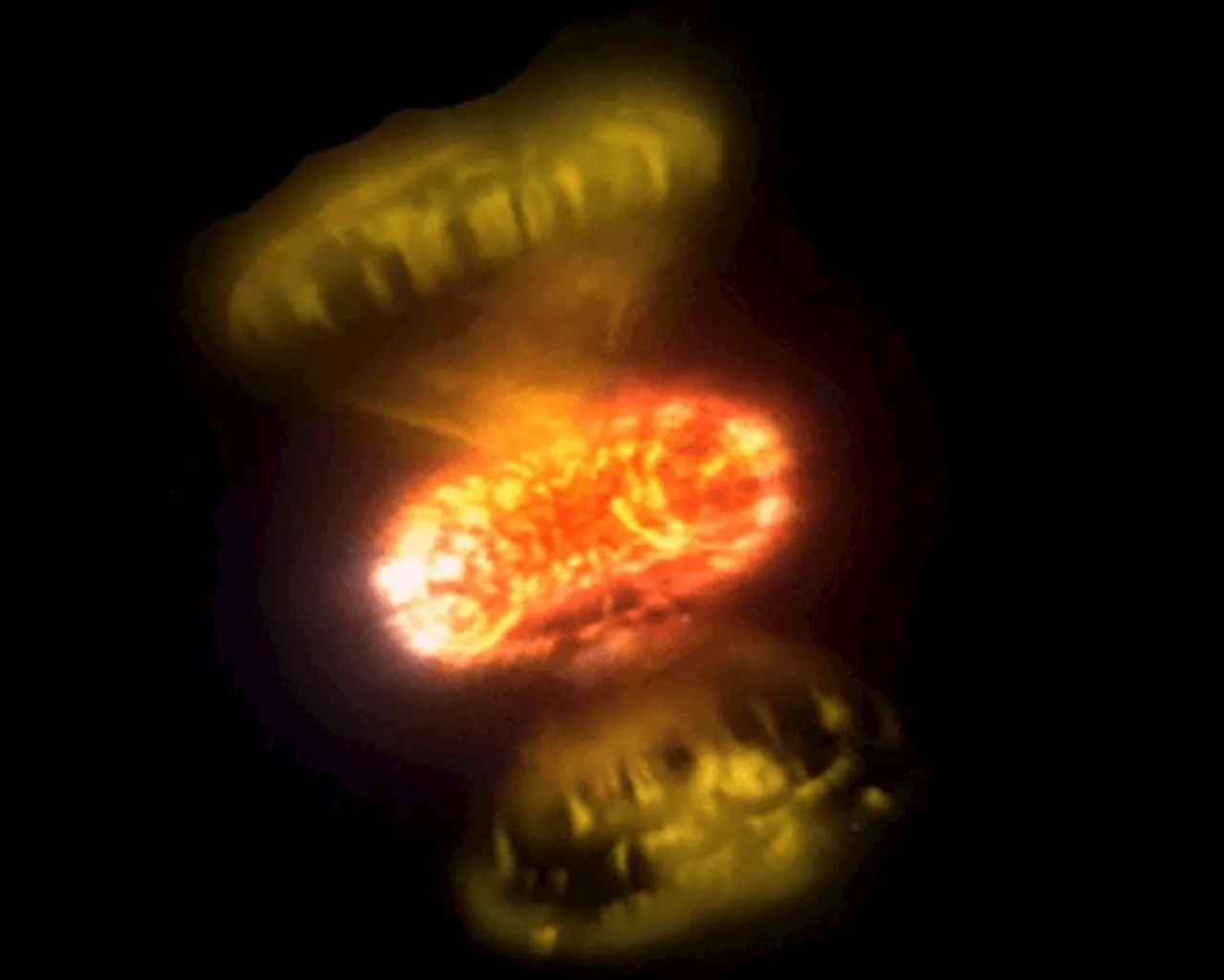
Recent observations focused on two specific novae: V1674 Her and V1405 Cas. The research team, led by Elias Aydi of Texas Tech University, utilized advanced imaging techniques to capture unprecedented details of these explosions. “These observations allow us to watch a stellar explosion in real time, something that is very complicated and has long been thought to be extremely challenging,” Aydi commented.
Insights from V1674 Her and V1405 Cas
The nova V1674 Her was categorized as a fast nova, with images taken just 2-3 days post-explosion revealing material being expelled in two perpendicular outflows. This evidence indicates the presence of multiple interacting ejections. In contrast, V1405 Cas is classified as a slow nova. It did not show significant expelled material until 50 days after its explosion, marking the first evidence of delayed ejection from a nova.
According to the researchers, “The formation mechanisms of the energetic shocks that lead to the GeV γ-ray emission from novae are still poorly constrained.” The observations suggest that shocks occur within the ejecta at the interface of multiple ejections, creating the conditions for particle acceleration and high-energy gamma-ray emissions.
The team employed two observational techniques: interferometry and spectrometry. The Georgia State University CHARA Array was instrumental in obtaining fine details of the explosions, while spectrometry provided chemical fingerprints of the evolving ejecta. A critical aspect of their findings was the alignment of spectral data with the structures revealed through interferometry, validating the dynamics of material collisions.
Implications for Stellar Physics
The observations from these novae present a significant leap in understanding stellar explosions. John Monnier, a co-author and professor at the University of Michigan, expressed, “The fact that we can now watch stars explode and immediately see the structure of the material being blasted into space is remarkable.”
The implications of this research extend beyond mere observation. Laura Chomiuk, another co-author from Michigan State University, emphasized that novae serve as natural laboratories for extreme physics. “By seeing how and when the material is ejected, we can finally connect the dots between the nuclear reactions on the star’s surface, the geometry of the ejected material, and the high-energy radiation we detect from space,” she stated.
These findings challenge the traditional view of novae as simple explosive events. The research suggests a more intricate picture, with multiple outflows and varying ejection timings. “This is just the beginning,” Aydi remarked. “With more observations like these, we can finally start answering big questions about how stars live, die, and affect their surroundings.”
The research team plans to expand their observations, aiming to determine if the delayed ejection phenomenon observed in V1405 Cas is common across other novae. “By increasing the sample of novae observed with CHARA and other optical and NIR interferometers in the future, we can confirm if this delayed ejection is common in other novae,” they concluded.
Overall, these observations not only enhance our understanding of nova explosions but also set the stage for further exploration into the dynamics of stellar evolution and the extreme environments of the cosmos.