The expansion of the universe is facing a significant conundrum as researchers at the University of Tokyo introduce a new method to measure its rate. The findings suggest that the discrepancy in measurements of the universe’s expansion, known as the Hubble tension, may indicate a deeper understanding of cosmic physics rather than mere observational errors. This research is poised to reshape cosmology as we know it.
Understanding the Hubble Tension
For decades, astronomers have depended on distance markers such as supernovae to gauge how quickly the universe expands. This method, which determines the Hubble constant, currently estimates the expansion rate at approximately 73 kilometres per second per megaparsec. This means that for every 3.3 million light years from Earth, objects recede at a rate of 73 kilometres per second.
The issue arises when scientists employ alternative methods to measure the same phenomenon. By analyzing the cosmic microwave background—the ancient radiation left over from the Big Bang—they derive a different expansion rate of 67 kilometres per second per megaparsec. This significant gap has sparked extensive debate in the scientific community, as it may indicate unknown physics at play.
A Breakthrough in Measurement Techniques
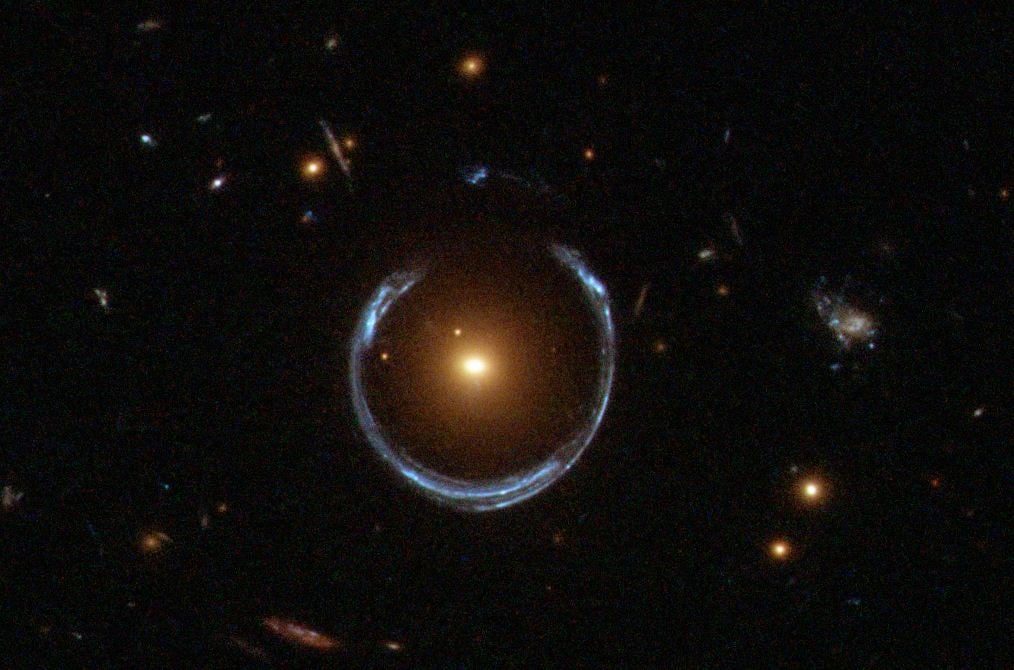
Project Assistant Professor Kenneth Wong and his team at the Research Centre for the Early Universe have now employed an innovative technique known as time delay cosmography. This method circumvents traditional distance measurements by utilizing gravitational lensing, where massive galaxies distort light from more distant objects.
In ideal conditions, a single distant quasar appears as multiple distorted images around the lensing galaxy. Each image takes a different path to reach Earth, resulting in varying travel times. By observing changes in these images occurring slightly out of sync, astronomers can calculate the time differences between the paths. Combining this data with models of mass distribution in the lensing galaxy leads to an accurate measurement of the universe’s expansion rate.
The research team analyzed eight gravitational lens systems using advanced telescopes, including the James Webb Space Telescope. Their measurements align closely with the 73 kilometres per second per megaparsec figure from nearby observations, contrasting sharply with the 67 kilometres per second per megaparsec derived from early universe calculations. This alignment strengthens the argument that the Hubble tension represents a genuine phenomenon rather than a result of systematic errors in traditional methods.
The current precision of this measurement stands at approximately 4.5 percent. To confirm the existence of Hubble tension definitively, researchers aim to enhance this precision to between 1-2 percent. Achieving this will require further analysis of additional gravitational lens systems and more refined models of mass distribution within the lensing galaxies.
One of the main uncertainties arises from the current understanding of how mass is arranged within these galaxies. Researchers continue to assume profiles that are consistent with observational data. This groundbreaking work highlights decades of collaboration among international observatories and research teams.
If the Hubble tension is validated, it could herald new physics and usher in a transformative era in cosmology, fundamentally altering our comprehension of the universe’s evolution. The implications of this research extend beyond theoretical boundaries, potentially reshaping our understanding of the cosmos itself.