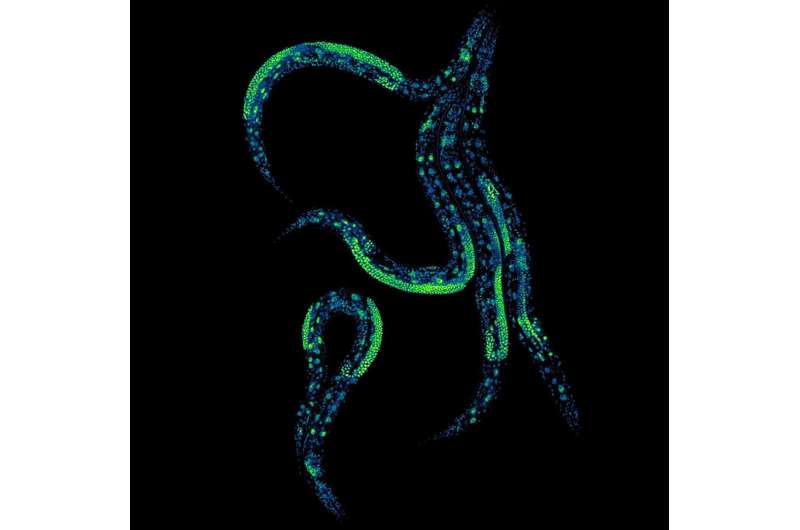
Researchers have developed a groundbreaking method that allows precise control of protein levels within living animals for the first time. This innovative technique enables scientists to adjust protein concentrations throughout an animal’s lifespan, providing new insights into the molecular mechanisms of aging and disease. The work, conducted by scientists at the Center for Genomic Regulation in Barcelona and the University of Cambridge, is documented in the journal Nature Communications.
This study marks a significant advancement in biological research, as it permits detailed exploration of protein functions within various tissues. By manipulating protein levels with high accuracy, researchers can investigate the impact of proteins on health and the interconnectedness of biological systems. According to Dr. Nicholas Stroustrup, a researcher at the Center for Genomic Regulation and senior author of the study, “No protein acts alone. Our new approach lets us study how multiple proteins in different tissues cooperate to control how the body functions and ages.”
The implications of this research are profound, particularly for understanding aging, which involves intricate interactions between different organs. Traditional techniques have struggled to isolate the effects of proteins on lifespan, often limiting studies to simplistic on/off gene experiments. This new method overcomes those limitations by providing a nuanced approach to protein manipulation.
Understanding the Dual-Channel AID System
The technique is based on an adaptation of the auxin-inducible degron system (AID system), originally developed for plant biology. In plants, a hormone called auxin regulates growth by controlling protein levels. Researchers have now repurposed this concept for animal studies. The AID system utilizes a tagging mechanism—known as a degron—that labels proteins for degradation by an enzyme called TIR1, but only in the presence of auxin. When auxin is removed, the protein is restored.
By engineering different versions of the TIR1 enzyme, the researchers created a flexible “dual-channel” AID system. This allows precise control over protein levels in specific tissues without disrupting the animal’s normal life functions. The method enables scientists to adjust protein concentrations dynamically, providing a powerful tool for experimental biology.
The researchers tested the system on the nematode worm Caenorhabditis elegans, examining protein levels in both the intestines and neurons. By feeding the worms auxin-infused food, the plant hormone activates the TIR1 enzyme, which then regulates protein levels in targeted tissues. This dual control system is particularly significant as it allows independent manipulation of the same protein in different parts of the body.
Expanding Research Horizons
One of the key challenges researchers faced was the AID system’s ineffectiveness in reproductive tissues. This limitation has now been addressed by adapting the system to work across the entire organism, including reproductive cells. As noted by Dr. Jeremy Vicencio, a postdoctoral researcher at the Center for Genomic Regulation, “Getting this to work was quite an engineering challenge. We had to test different combinations of synthetic switches to find the perfect pair that didn’t interfere with one another.”
The implications of this technique extend beyond mere academic interest. By facilitating precise control over protein levels, researchers can now explore questions previously deemed unanswerable, such as how varying protein concentrations contribute to health or how minor changes in one tissue can affect the entire organism.
This innovative approach represents a significant leap forward in the field of molecular biology, offering new avenues for research into the complexities of life processes. As scientists continue to refine this method, it is anticipated that it will lead to groundbreaking discoveries in aging and disease management.
For further details, the study is available in Nature Communications, published on December 12, 2025.