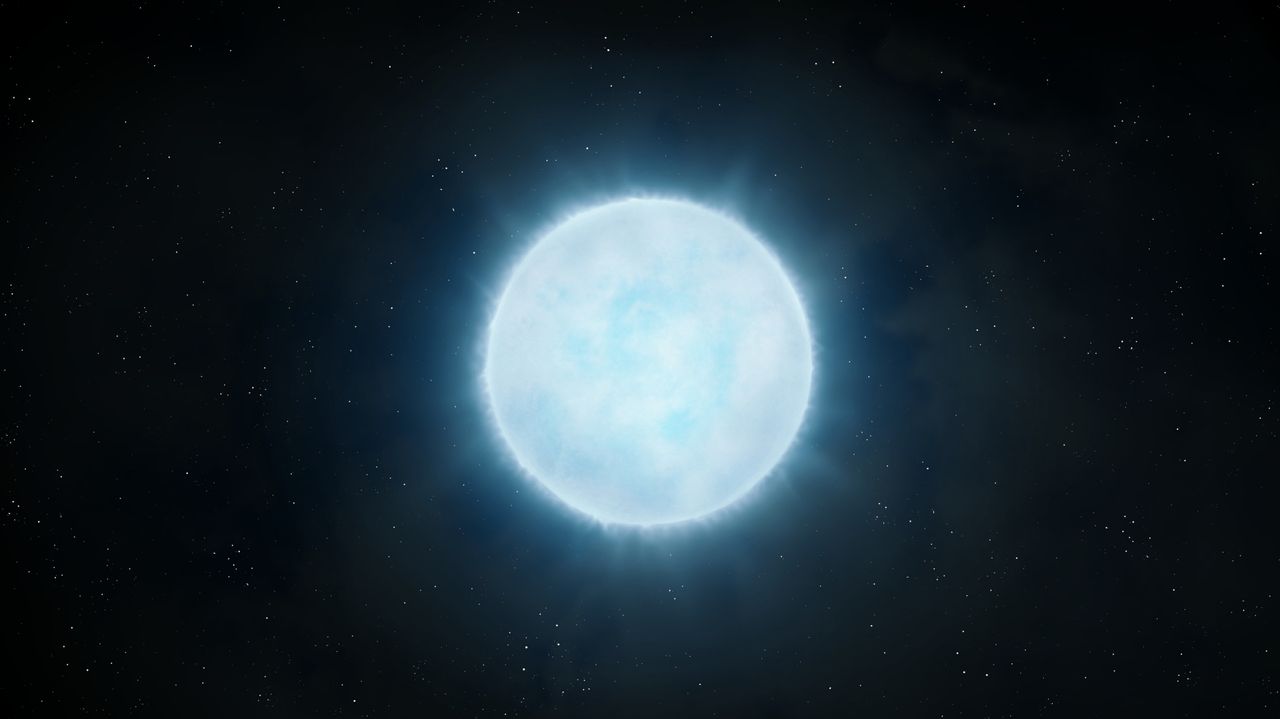
Astronomers are delving deeper into the enigma of dark matter by examining the cooling rates of white dwarfs, the remnants of dead stars. Their recent research, published in November 2025, focuses on the theoretical particle known as the axion, which may play a crucial role in understanding the universe’s unseen components.
Once considered a solution to a problem with the strong nuclear force, the axion faded from prominence after initial searches in particle colliders yielded no results. However, renewed interest emerged when scientists began to consider its potential connection to dark matter. The axion could be flooding the universe while remaining elusive to direct detection.
In their study, researchers employed archival data from the Hubble Space Telescope to investigate the implications of axion production within white dwarfs. These dense stellar remnants, which can contain the mass of the sun within a volume smaller than Earth, are supported against gravitational collapse by a phenomenon called electron degeneracy pressure. This occurs when a large number of electrons resist being in the same state, a principle derived from quantum mechanics.
The study proposes that if electrons within a white dwarf are moving at high velocities, they could potentially produce axions. As these particles escape, they would carry away energy, causing the white dwarf to cool more rapidly than expected. Given that white dwarfs do not generate energy independently, this cooling effect could serve as a critical indicator in the search for axions.
To test their hypothesis, the researchers developed a sophisticated model that simulates the thermal evolution of stars. This model predicted the temperature of a white dwarf based on its age, taking into account both scenarios: one with axion cooling and one without.
The focus of their observations was the globular cluster 47 Tucanae, which is significant because all white dwarfs within it formed around the same time. By analyzing data collected from Hubble, the researchers sought evidence of axion-induced cooling in this population of stars.
The findings revealed no support for axion cooling, yet they provided crucial constraints on the likelihood of electrons producing axions. The results indicate that electrons cannot create axions more efficiently than once every trillion interactions. While this does not eliminate the existence of axions, it suggests that their interaction with electrons is improbable.
This research not only sheds light on the potential behaviors of axions but also emphasizes the necessity for innovative methods in their ongoing search. As scientists continue to investigate the mysteries of dark matter, the study of white dwarfs may offer valuable insights, guiding future exploration in this complex field of astrophysics.