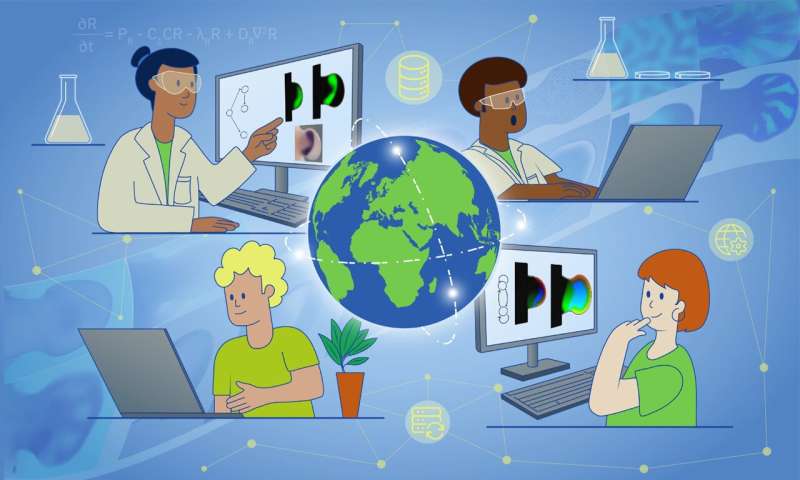
Researchers at the European Molecular Biology Laboratory (EMBL) in Barcelona have introduced LimbNET, an innovative online platform designed to transform the study of limb development. Launched on December 4, 2025, this open-access tool enables scientists to simulate and manipulate gene regulatory networks, allowing for greater collaboration and exploration within the field.
Empowering Researchers Through Collaboration
LimbNET is not merely a data repository; it serves as a collaborative environment where researchers can define and simulate custom networks. This centralization of models and data aims to enhance transparency and cooperation among scientists working on limb development. As Antoni Matyjaszkiewicz, the first author of the study and Research Staff Scientist in EMBL’s Sharpe Group, explained, “Our aim with LimbNET is to have everything in one place, so that the data, the models, and the simulations are not scattered across research groups, countries, and institutes.”
The platform facilitates easy access, eliminating the need for software downloads. Users worldwide can engage with LimbNET through their web browsers, democratizing access to advanced modeling tools for the global scientific community. This initiative aims to empower researchers and foster an environment of cumulative knowledge building.
Transforming Scientific Publishing
One of the most significant aspects of LimbNET is its potential to change how scientific research is published. According to James Sharpe, Head of EMBL Barcelona and senior author of the study, the platform allows researchers to present interactive and extendable versions of their studies. “It presents an accessible, dynamic version of the simulations that anyone can adjust, explore, and challenge,” he noted.
This approach represents a shift away from traditional publishing, where findings are presented in static formats. Instead, LimbNET enables researchers to share their methodologies and findings in an interactive manner, promoting reproducibility and critical engagement within the scientific community.
“This is like going from a static cookbook with text and photos to a kitchen where you can try the recipe yourself,” Sharpe added. By providing a living ecosystem of models, LimbNET allows research to evolve as new data emerges, creating opportunities for real-time collaboration and innovation.
Fostering Interdisciplinary Conversations
While still in its early stages, the LimbNET project has the potential to bring together scientists with varying levels of experience in computational modeling. The platform’s user-friendly interface allows researchers to start with existing models rather than creating new ones from scratch. This approach encourages interdisciplinary discussion among peers from different scientific backgrounds.
Matyjaszkiewicz emphasized the importance of fostering conversations between experimentalists and computational researchers. “This tool can help us refine experiments and rethink how we approach hypotheses,” he stated. Currently, many hypotheses are expressed qualitatively, and LimbNET aims to convert these verbal models into tangible, quantitative simulations.
Community Response and Future Prospects
The scientific community has welcomed LimbNET as an innovative tool for studying limb development. Rolf Zeller, a Professor at the University of Basel, praised the platform for facilitating a shift from studying gene interactions to integrative analyses of complex networks. “LimbNET opens an exciting and innovative new avenue as it facilitates moving from studying gene interactions to integrative analysis of complex networks,” he remarked.
As LimbNET continues to develop, the authors believe it will encourage more researchers to engage in modeling. By simplifying access to computational tools, the platform aspires to grow the portfolio of available models in limb development research, ultimately advancing understanding in this critical area of biology.
For more information, readers can refer to the full study published in Molecular Systems Biology (2025), DOI: 10.1038/s44320-025-00128-y.