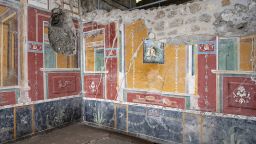
Nearly two millennia after the catastrophic eruption of Mount Vesuvius in AD 79, which buried the city of Pompeii in a thick layer of ash and debris, researchers are employing advanced digital techniques to unveil the “lost Pompeii.” The project aims to reconstruct architectural elements that have been hidden for centuries, providing new insights into the daily lives of its ancient inhabitants.
The eruption of Mount Vesuvius not only obliterated a thriving Roman city but also preserved its ruins in a state frozen in time. Since excavations began in 1748, archaeologists have uncovered an array of buildings, artifacts, and even the remains of residents who were trapped or perished in the disaster. Yet significant portions of the city’s architecture remained undiscovered, leading to ongoing questions about the social dynamics and daily activities in Pompeii.
Recent findings from the Pompeii Reset project, coordinated by researchers from **Humboldt University**, utilize a blend of digital archaeology, including remote sensing technology, close-range photography, and traditional excavation techniques. “By reconstructing the lost architecture, we gain a more nuanced and historically accurate understanding of the ancient city and life within it,” noted Dr. Susanne Muth, co-lead study author and professor at Humboldt University’s Institute for Archaeology.
New Techniques Illuminate the Past
During a 2022 visit to Pompeii with students, Muth was inspired by ongoing efforts to preserve the site and proposed a non-invasive method of digital reconstruction to complement traditional archaeology. The Archaeological Park of Pompeii embraced this idea, collaborating with Humboldt University, which has a reputation for integrating digital methods in archaeological studies.
Utilizing **LiDAR** (light detection and ranging) scans and high-resolution photography, the team documents the existing structures and creates detailed 3D models of the site. Scans reveal clues such as holes indicating missing architectural elements, enabling researchers to digitally reconstruct how these structures may have appeared before the catastrophic eruption.
Explorations have shown that some residents returned to Pompeii decades after the initial disaster, constructing makeshift living spaces amidst the ruins. “The volcanic debris and ash covering Pompeii after the eruption reached approximately five meters height,” stated Gabriel Zuchtriegel, director of the archaeological park. He added that remnants of upper floors could still be seen peeking out from the ash, indicating a complex societal structure that included both wealthy and poorer citizens.
As researchers delve deeper into the upper floors of Pompeii’s buildings, they are uncovering significant findings that challenge previous assumptions. The focus on the recently excavated **Casa del Tiaso**, or the House of the Thiasos, revealed a monumental stone staircase leading to a possible upper floor, suggesting the presence of a tower structure that could have once been a prominent feature of the city’s skyline.
A Glimpse into Luxurious Living
The Casa del Tiaso is believed to have belonged to an influential family, featuring lavish banquet rooms, a garden courtyard, and a private thermal bath complex. Such residences were designed to display wealth and social standing, similar to the large country villas described by Roman writer **Pliny the Younger**.
Historically, towers were common in rural villas but were rarely identified within urban architecture. The findings at the Casa del Tiaso indicate that wealthy families in Pompeii may have emulated these architectural styles. “The unique findings in the Casa del Tiaso now lead us to believe that such towers also existed in cities as an element of wealthy residential architecture,” Muth explained.
The potential existence of these towers raises questions about the architectural landscape of Pompeii. Archaeologists have historically overlooked such structures in urban settings due to their sprawling designs. Yet, the evidence suggests that the city may have had a more complex and visually striking skyline than previously understood.
Innovative Reconstruction Efforts
The process of digitally reconstructing Pompeii’s architecture resembles detective work, with researchers meticulously gathering evidence from various sources. They employ drones for large-scale scans, laser technology for precise measurements, and photogrammetry to create accurate 3D models. “Step by step, a 3D model emerges on which we can transparently develop our arguments and proposals,” Muth stated, emphasizing the collaborative nature of this work.
The digital models allow for a rigorous examination of ancient living spaces, enabling virtual walk-throughs that can illuminate aspects of daily life in Pompeii. Muth elaborated, “We can more concretely visualize a banquet by candlelight or a celebration at the top of the tower of the Casa del Tiaso, but also the oppressive working conditions in the so-called slave bakery next door.”
While researchers continue to explore the potential for more tower-like structures within Pompeii, they acknowledge the challenges of preserving such historical sites for future generations. Zuchtriegel emphasized that digital archaeology serves not only to reconstruct ancient buildings but also to facilitate a deeper understanding of their functional use and cultural significance.
The overarching goal of the Pompeii Reset project is to digitally reconstruct as many buildings as possible, contributing to the preservation of Pompeii’s cultural heritage. Since excavations began, over 13,000 rooms have been uncovered, with a significant portion of the city still buried beneath volcanic ash.
As the team progresses, they hope to reveal more about the lives of ordinary citizens and the architectural innovations that characterized this ancient city. The insights gained from these efforts could transform our understanding of Pompeii, allowing contemporary society to appreciate the complexities and vibrancy of life in this remarkable Roman city.