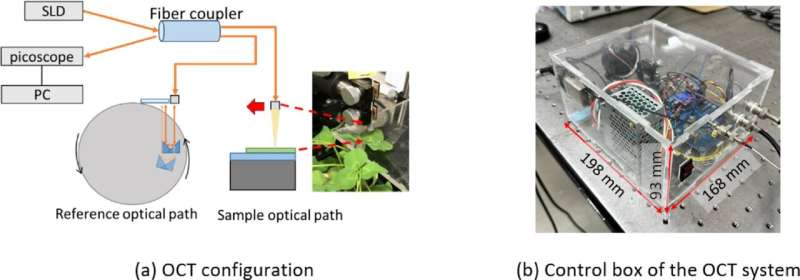
Researchers from an international collaboration have developed a portable optical coherence tomography (OCT) scanner capable of detecting hidden ozone damage in plant leaves. This innovative technology offers a non-invasive method to evaluate environmental stressors affecting plant health, potentially transforming agricultural monitoring practices.
Addressing Environmental Threats
As pollution continues to escalate, particularly in urban and industrial areas, the impact on plant growth is becoming increasingly severe. Elevated ozone levels are known to inhibit growth and reduce crop yields, yet traditional methods of assessment often fall short. Conventional evaluations rely heavily on visual inspections and microscopic examinations, which can be invasive and may not yield accurate quantitative measurements over time.
The new OCT scanner, developed by a team led by Associate Professor Tatsuo Shiina and Dr. Hayate Goto from Chiba University, in collaboration with researchers from the University of the Philippines, Visayas and De La Salle University, aims to overcome these challenges. The findings of their study are published in the journal Scientific Reports.
Innovative Technology in Action
The researchers tested their OCT scanner on the leaves of white clover (Trifolium repens), a plant known for its sensitivity to environmental pollutants. By exposing these plants to high concentrations of ozone, they monitored changes over a period of 14 days. The results highlighted significant alterations in the internal structure of the leaves, particularly within the palisade tissue, which is crucial for photosynthesis.
“By using OCT, the internal structure can be non-destructively quantified layer by layer to identify areas affected by the external environment,” stated Dr. Shiina. “Since stress responses in plants appear first in the interior of the plant, OCT has the potential to elucidate environmental stresses that cause internal changes in plants.”
The experiments demonstrated that ozone exposure led to a decrease in light scattering within the palisade layer, indicating structural damage to cell walls and intercellular boundaries. Additionally, researchers observed a gradual increase in palisade tissue thickness, which correlated with the decrease in OCT signal intensity.
Following initial laboratory tests, the team expanded their research to field studies across four regions in the Chiba Prefecture, Japan, where ozone concentrations ranged from 0.04 to 0.16 ppm. Consistent trends in the OCT parameters of sampled leaves suggested that internal structural characteristics could effectively reflect levels of ozone exposure.
This on-site measurement capability negates the need for transporting samples, allowing for a more accurate assessment of ozone’s effects on plants. The research underscores the OCT scanner’s potential to provide timely evaluations of environmental stressors, facilitating early detection and intervention to minimize crop losses.
Overall, the findings illustrate the feasibility of using OCT for assessing environmental stress in plants, particularly at the cellular level before symptoms manifest. This non-invasive method offers a quicker and simpler alternative to traditional techniques, which often involve chemical fixation and staining.
Dr. Shiina emphasized the broader implications of this research, stating, “Continued research in this direction could expand OCT’s utility in optimizing crop environments and improving agricultural productivity. The ability to estimate atmospheric and soil conditions on-site from a single OCT measurement provides a promising approach to advancing crop management and environmental monitoring.”
Future studies will further validate the effectiveness of this technology under varying environmental conditions, including changes in humidity, temperature, and light intensity. As researchers continue to explore the capabilities of the OCT scanner, its potential contributions to agriculture and environmental science remain significant.