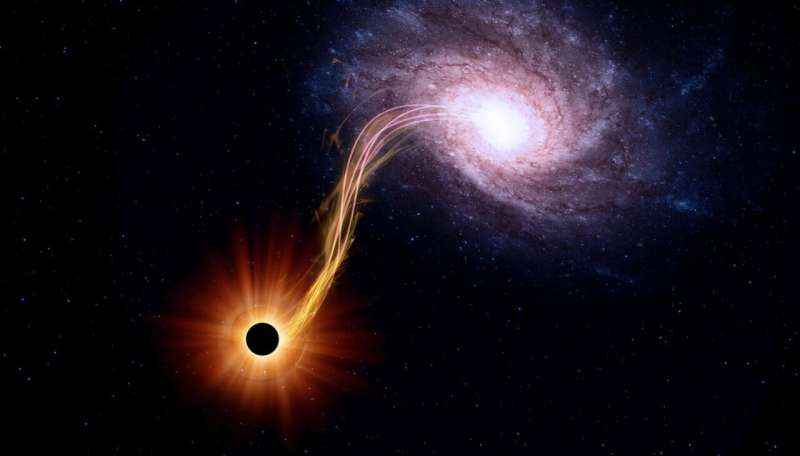
A new study led by physicist Robert Scherrer from Vanderbilt University investigates the potential effects a small primordial black hole could have on the human body. Published in the International Journal of Modern Physics D on November 21, 2025, the research aims to deepen the understanding of dark matter by examining how these theoretical cosmic entities interact with human physiology.
Primordial black holes are hypothetical formations believed to have emerged in the early universe, potentially shortly after the Big Bang. Their masses could vary dramatically, ranging from as light as a paperclip to as heavy as 100,000 solar masses. Some scientists propose that these black holes may account for a portion, or possibly all, of the universe’s dark matter.
In his article, Scherrer addresses the critical question of how large a primordial black hole would need to be to inflict significant harm on a human. This exploration builds on Scherrer’s previous research in collaboration with colleagues Jagjit Singh Sidhu and Glenn Starkman from Case Western Reserve University, where they studied macroscopic dark matter (MACROs). Their findings suggested that MACROs could cause substantial destruction to human tissue, which informs the ongoing investigation into primordial black holes.
Scherrer noted, “I knew that I could carry over some of those calculations to the study of primordial black holes.” Recent advancements in black hole imaging and gravitational wave observations have rekindled interest in these phenomena, prompting Scherrer to explore their potential human impact. He reminisced about a science fiction story from the 1970s that depicted a character dying from a black hole passing through them, leading him to investigate the plausibility of such an event.
Examining the Potential Dangers
The research identifies two primary gravitational effects that a primordial black hole could produce when passing through the human body: supersonic shock waves and tidal gravitational forces. A supersonic shock wave emerges when an object moves faster than the speed of sound, generating a cone-shaped disturbance. If a primordial black hole were to traverse a human body, it would create these shock waves, resulting in tissue damage akin to that of a bullet wound.
Additionally, tidal gravitational forces arise from the differential strength of gravity at two points. This effect would create a tensile force that could stretch and tear human cells, especially those in the brain, which are particularly vulnerable to such intense forces.
While these revelations help scientists better understand primordial black holes as a component of dark matter, Scherrer reassures the public about the improbability of such encounters. “Primordial black holes are theoretically possible, but they might not even exist,” he stated. A black hole the size of an asteroid or larger could indeed cause severe injury or death, acting similarly to a gunshot. However, smaller primordial black holes could pass through a person without detection. Given their extremely low density, the likelihood of experiencing an encounter with one is virtually nonexistent.
The implications of this research extend beyond theoretical physics, contributing to the ongoing dialogue regarding the nature of dark matter and its cosmic significance. Scherrer’s study serves as a reminder of the fascinating and often unexpected intersections between fundamental physics and human experience.
For further details, refer to Scherrer’s original article, “Gravitational effects of a small primordial black hole passing through the human body,” published in the International Journal of Modern Physics D.