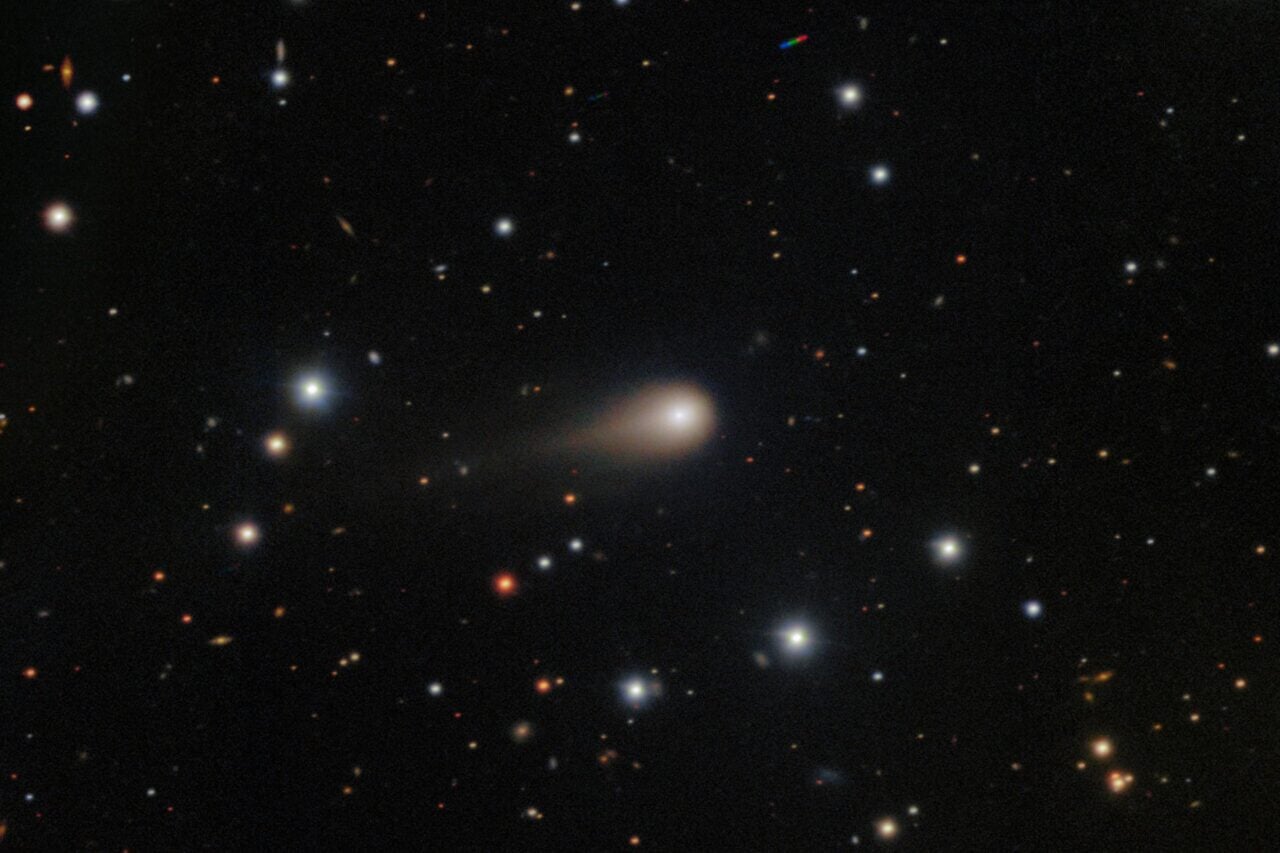
Astronomers have conducted a thorough search for artificial signals emanating from the interstellar object known as 3I/ATLAS. Following its discovery, scientists widely agreed that it is a comet originating from outside our solar system. Nonetheless, speculation lingered about its possible artificial nature, particularly after Avi Loeb, a Harvard University astronomer, suggested it could be an alien spacecraft. Recent findings, however, indicate that the chances of 3I/ATLAS being anything other than a natural object are exceedingly slim.
Technosignature Search Yields No Evidence
The Breakthrough Listen program, a significant scientific initiative aimed at detecting signs of extraterrestrial civilizations, spearheaded the technosignature search for 3I/ATLAS. The search took place as the comet approached its closest point to Earth on December 18, 2023. Utilizing the Robert C. Byrd Green Bank Telescope in Green Bank, West Virginia, researchers aimed to scan for artificial radio signals.
During the search, scientists initially detected approximately 470,000 signals that appeared potentially artificial. After further analysis, only nine signals remained as candidates. However, these were ultimately dismissed as human-made radio interference. The study authors concluded, “There is currently no evidence to suggest that [interstellar objects] are anything other than natural astrophysical objects.”
Insights on Interstellar Objects
Despite the lack of evidence supporting extraterrestrial origins, the findings highlight the significance of 3I/ATLAS as a remarkable astronomical discovery. It represents only the third interstellar object identified to date. The comet is notably different from its predecessors, being older, larger, and faster, and it possesses unique chemical and physical characteristics.
As 3I/ATLAS continues its journey back into interstellar space, astronomers remain committed to analyzing the extensive data collected throughout the research. Although this study did not identify signs of intelligent extraterrestrial life, it contributes to a growing understanding of distant star systems and the nature of interstellar objects.
The research underscores the importance of ongoing investigations into these cosmic phenomena, reinforcing the notion that even in silence, 3I/ATLAS holds invaluable scientific insights.