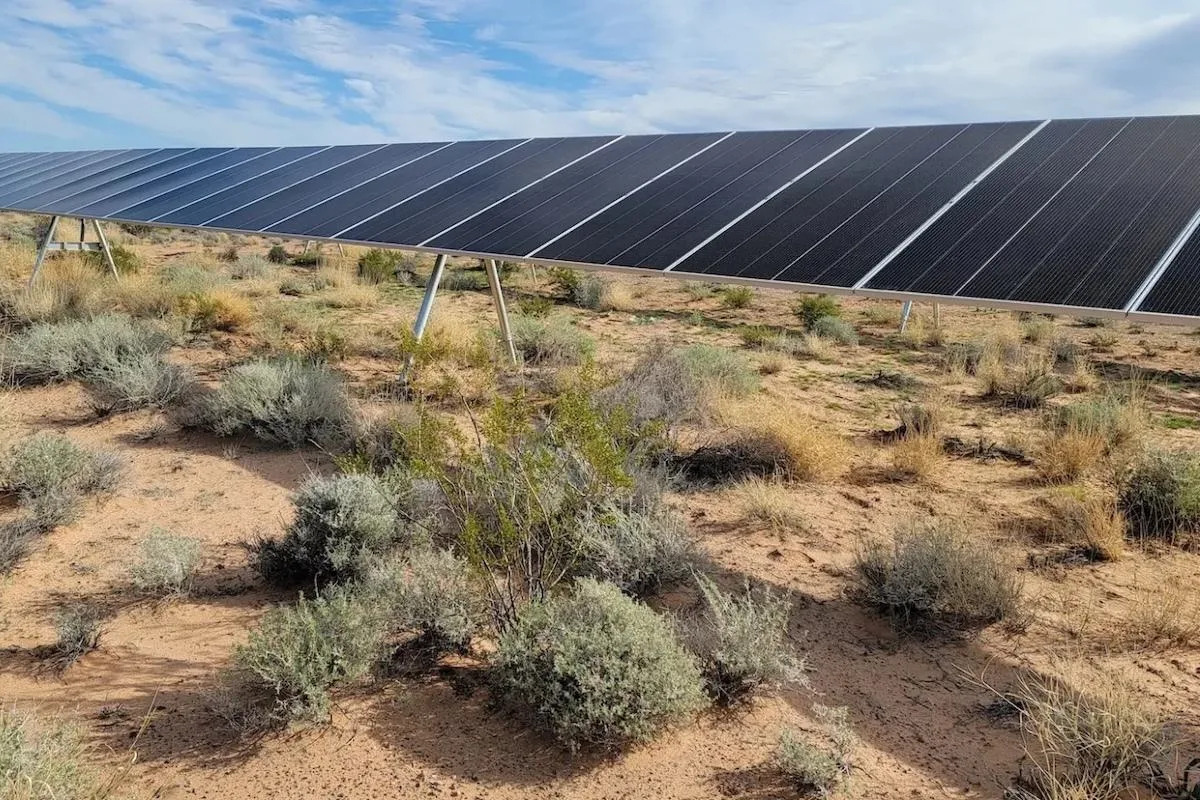
A solar farm near Las Vegas has become an unexpected sanctuary for a rare desert plant, according to a recent study. The research highlights how the Mojave Desert, often seen as barren, supports a diverse range of flora and fauna, including the threecorner milkvetch, a member of the pea family. This resilient plant thrives under harsh conditions, emerging only after rainfalls to flower and reproduce. While the threecorner milkvetch is currently being considered for protection under the Endangered Species Act, it remains vulnerable to environmental disturbances, such as those caused by traditional solar farm construction techniques.
At the Gemini Solar Project, developers adopted a less invasive method. Instead of the conventional “blade and grade” approach that disrupts the soil and removes native vegetation, the project focused on preserving the existing ecosystem. The study, conducted by researchers from the Desert Research Institute, found that before construction began in 2021, only 12 threecorner milkvetch plants were identified at the site. By 2024, that number had increased to 93, demonstrating that the seeds had survived the building process.
The plants at Gemini exhibited remarkable growth. They not only became wider and taller but also produced more flowers and fruits compared to those in a nearby area that employed traditional construction methods. One hypothesis for this success is the shade provided by solar panels, which reduces evaporation and increases soil moisture availability. As Tiffany Pereira, an ecologist and lead author of the study, noted, “So you just have the potential for a lot more plants.”
Innovative Approaches Foster Biodiversity
This research underscores the potential for solar farms to be designed in ways that minimize ecological disruption. The technique referred to as “ecovoltaics” involves planning solar facilities with an emphasis on native species. For example, crews can enrich the soil with native grasses and flowers to foster biodiversity. Lee Walston, an ecologist at Argonne National Laboratory, emphasized the importance of this approach, suggesting that such practices not only support plant life but also attract pollinators and other wildlife.
In Minnesota, similar initiatives have led to significant increases in biodiversity at solar sites. Walston’s research observed a sevenfold increase in unique flowering plant species and a tripling of insect pollinators over five years. Native bee populations surged by a staggering 20 times. Birds and bats have also been drawn to these areas, likely due to the abundance of insects.
The ability to create such favorable conditions, however, varies by species. For the threecorner milkvetch, the majority were found in sunnier areas between solar panels, with only one plant thriving directly under a panel. This highlights the necessity for careful planning regarding the height and spacing of solar structures, as taller panels can accommodate larger plants while requiring more materials and costs.
Balancing Energy Needs with Ecological Health
While there are challenges to achieving optimal biodiversity in solar farm designs, the potential benefits are significant. The incorporation of conservation grazing practices, such as using livestock to manage invasive weeds, can further enhance the ecological integrity of solar sites. This method replicates natural disturbances historically caused by wildlife and wildfires.
The advantages of ecovoltaics extend beyond mere plant survival. Johanna Neumann, senior director at Environment America, highlighted the potential for solar farms to restore agricultural fields to a more natural state. This approach counters the traditional blade-and-grade method, which not only disrupts habitats but also leads to soil degradation and the proliferation of invasive species.
Moreover, the concept of “agrivoltaics”—growing crops alongside solar installations—holds promise for enhancing food production while generating renewable energy. Horticulturist Jennifer Bousselot noted the potential for high-value crops to thrive in the microclimates created by solar panels, which can mitigate temperature extremes and reduce water usage.
The findings from the Gemini Solar Project and similar initiatives underscore a vital shift in how renewable energy can coexist with ecological preservation. As Pereira aptly stated, “Rather than a moonscape of invasive species and dust blowing into cities, why not strive for something better?” This evolving perspective can lead to a future where solar energy contributes not only to clean electricity but also to the health of our ecosystems.