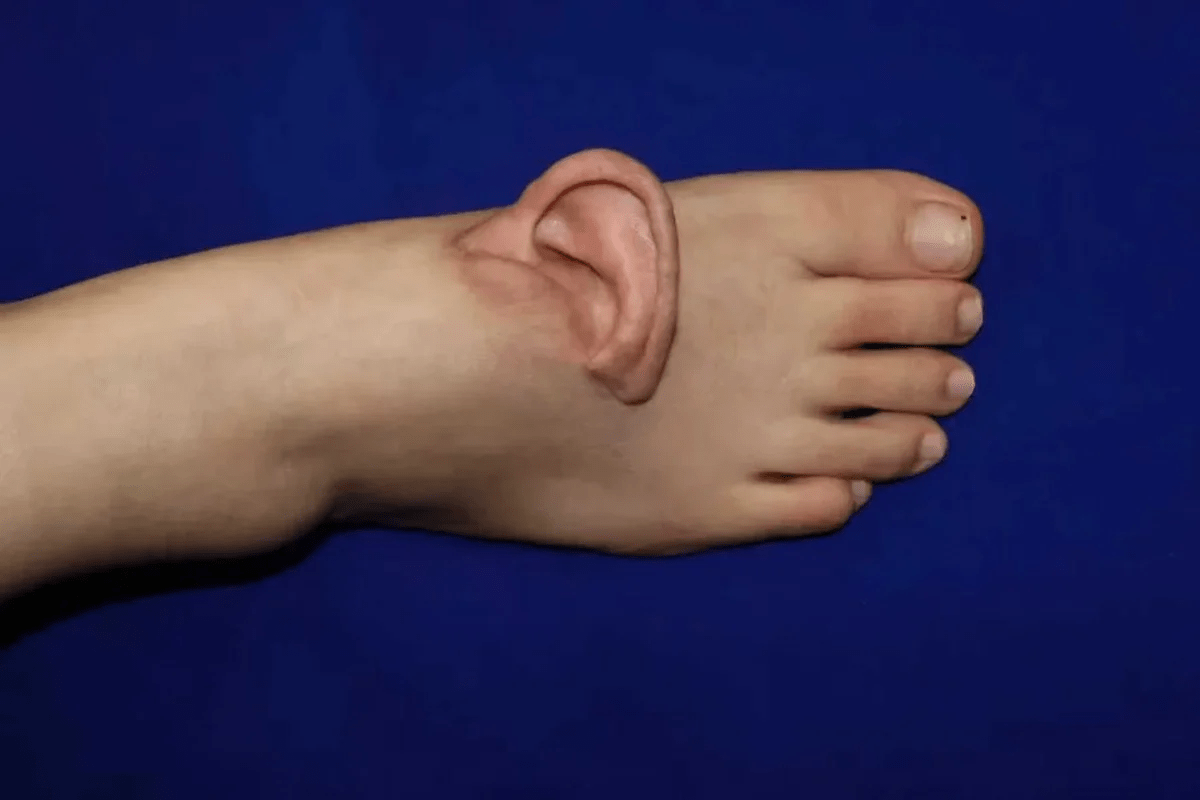
In a groundbreaking medical procedure, surgeons in Jinan, China, have successfully grafted a patient’s severed ear onto her foot. The patient, identified only by her surname, Sun, suffered severe injuries in a workplace accident involving heavy machinery, which resulted in the loss of a significant portion of her scalp along with her ear. According to Qiu Shenqiang, the deputy director of the microsurgery unit at Shandong Provincial Hospital, the conditions of her injuries made immediate reattachment of the ear impossible.
During the accident, Sun sustained devastating damage to her scalp and vascular network, leaving her face and neck “split into multiple fragments,” as described by Qiu. The ear had been “completely severed along with the scalp,” making the initial repair unfeasible. Given the complexity of her injuries, the medical team determined that her skull required several months to heal before the ear could be reattached.
Faced with this reality, the surgical team adopted an innovative approach: they decided to preserve the ear by attaching it to an alternative site on Sun’s body. The choice fell on her foot, as the arteries and veins in that area are compatible with those in the ear. Furthermore, the skin and soft tissue of the foot are similar in thickness to that of the head, making it a suitable temporary location for the graft.
This type of procedure, known as a heterotopic graft, is not common but has been used in organ transplants. However, grafting an ear to a foot had no precedent in medical history, which added an element of risk to the operation.
The initial grafting procedure took approximately ten hours. Surgeons worked meticulously to connect the ear’s delicate veins to those in the foot. Despite their efforts, complications arose shortly after the surgery. Five days post-operation, the ear began to turn purplish black, indicating that blood was pooling due to inadequate circulation.
In response, the medical team undertook a labor-intensive process called manual bloodletting, which required almost 500 individual interventions to rescue the ear. After stabilizing the ear, the surgeons gradually focused on restoring Sun’s scalp.
By March 2024, five months after the accident, Sun’s scalp and neck had healed sufficiently for the surgical team to reattach her ear to its original position. The procedure was completed in October 2023, and she has since been discharged from the hospital with her facial and tissue functions largely restored.
This remarkable case underscores the potential for innovative surgical techniques in trauma medicine and highlights the resilience of both patients and medical professionals in overcoming unprecedented challenges.