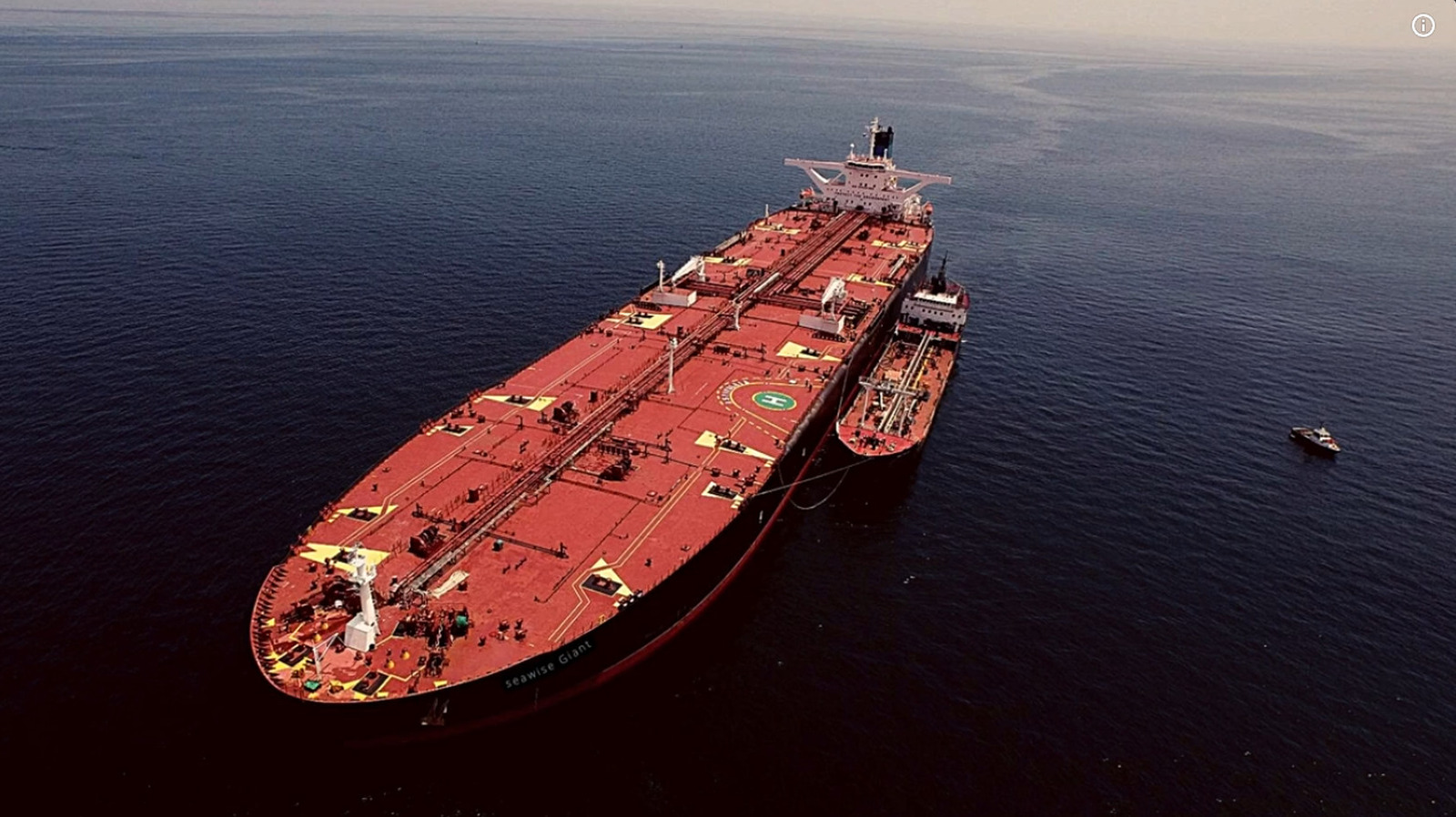
The Seawise Giant, once the largest ship and man-made moving object in history, had a remarkable journey that mirrored the ambitious spirit of human engineering. Originally conceived by Greek billionaire and shipping magnate Stavros Niarchos in the 1970s, this ultra-large crude carrier (ULCC) was launched with expectations of grandeur, ultimately becoming an icon of maritime history even after its decommissioning in 2010.
The construction of the Seawise Giant began in 1979 at the Oppama shipyard in Japan, operated by Sumitomo Heavy Industries. Measuring a staggering 1,504 feet in length, the ship was longer than four football fields. Its sheer size set it apart from all other vessels, surpassing the dimensions of the USS Enterprise, which was approximately 1,119 feet long, and the current largest ship, the MSC Irina, at just under 1,312 feet.
Niarchos’s vision faced hurdles right from the start. Reports suggest that he either went bankrupt or refused delivery due to various issues, including market downturns. By 1979, the vessel was sold to C.Y. Tung, the owner of Orient Overseas Container Line (OOCL), who extended its length and capacity before officially launching it as the Seawise Giant in 1981.
The ship’s specifications were extraordinary. With a deck measuring 339,500 square feet, crew members relied on bicycles to traverse its length, which could take up to 30 minutes to walk from one end to the other. The Seawise Giant could carry over four million barrels of crude oil across its 46 oil tanks. Despite its immense capacity, it was not the largest container ship by capacity; that title belonged to several vessels in the Evergreen A class, which could hold 24,004 TEU (twenty-foot equivalent units).
The ship’s impressive specifications included a 230-ton rudder and a 50-ton propeller. When fully loaded, it required nearly six miles to stop and had a turning circle exceeding two miles. Built with a one-inch-thick reinforced double hull, the Seawise Giant was engineered to withstand severe weather conditions.
Unfortunately, such vast size came with significant limitations. The Seawise Giant could not navigate through crucial maritime passages like the English Channel or the Suez Canal, often necessitating longer routes around the Cape of Good Hope. This factor, combined with a modest top speed of just 16 knots (approximately 18 mph), contributed to lengthy travel times.
The ship’s history took a dramatic turn during the Iran-Iraq War in 1988, when it was struck by Iraqi missiles in the Strait of Hormuz and sank. The owner at the time, OOCL, deemed it a total constructive loss. However, Normal International, a Norwegian company, invested millions to salvage and repair the vessel, which was then renamed the Happy Giant.
Soon after its relaunch, the vessel was sold to Norwegian shipping magnate Jørgen Jahre for $39 million. Jahre renamed the ship Jahre Viking, and it continued to transport crude oil for another decade. Eventually, advancements in shipping technology and a shift towards smaller, faster vessels rendered the Seawise Giant obsolete. In 2004, Jahre sold the vessel to First Olsen Tankers, which converted it into a floating storage and offloading (FSO) unit, renaming it the Knock Nevis.
The vessel operated at the Qatar Al Shaheen oil field until its sale for dismantling on March 15, 2009. The dismantling process was extensive, requiring 18,000 workers over a year to break the ship down into manageable pieces. The only remnant of the Seawise Giant that remains is its 36-ton anchor, now displayed at the Hong Kong Maritime Museum.
The tale of the Seawise Giant showcases not just the ambition of human engineering but also the complexities of navigating the ever-evolving maritime industry. Its legacy as the largest man-made moving object in history endures, reminding us of our capability to create monumental structures that define our time.