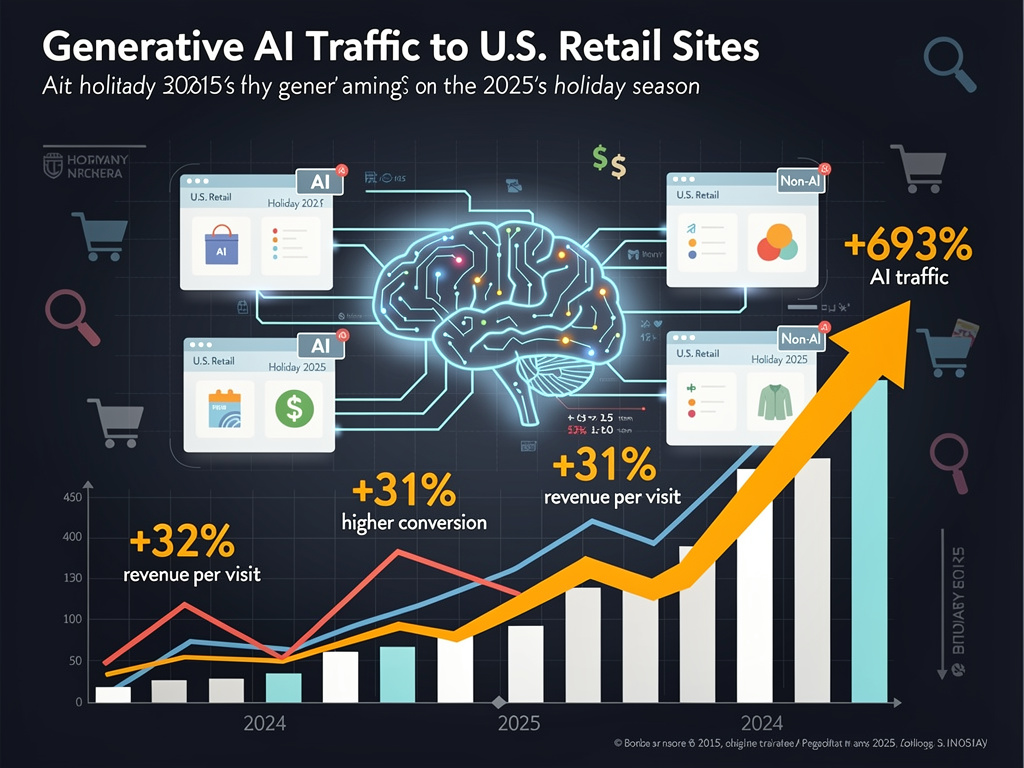
The 2025 holiday season saw a remarkable 693% year-over-year increase in traffic to U.S. retail websites, primarily driven by generative AI tools such as ChatGPT, Gemini, and Perplexity. This substantial surge occurred between November 1 and December 31, according to findings from Adobe’s Quarterly AI Traffic Report. Analyzing over one trillion visits and more than 100 million stock-keeping units, the report highlights that AI referrals not only increased traffic but also enhanced performance, converting at rates 31% higher than non-AI sources overall.
In a notable turnaround from 2024, when non-AI traffic outperformed AI by 51% in revenue per visit, AI-driven visitors in 2025 generated 32% more revenue per visit. Engagement metrics also soared, with AI traffic showing 14% higher engagement, 45% longer session times, and 13% more pages viewed per session. “AI-driven traffic surged across industries,” remarked Vivek Pandya, director of Adobe Digital Insights. “This means marketers and retailers alike saw deeper engagement translating directly into higher conversion rates during the 2025 holiday season.”
Broadening Impact Beyond Holidays
The influence of AI extended well beyond the holiday shopping period. The report noted triple-digit growth in AI referrals across multiple sectors, including travel at 539%, financial services at 266%, and technology/software. Overall, U.S. online holiday sales reached a record $257.8 billion, reflecting a 6.8% increase from $241.4 billion in 2024. This surge was bolstered by a remarkable 25 days where daily spending exceeded $4 billion, an increase from 18 days the previous year.
The transition of AI from a novelty tool to a significant revenue driver accelerated after a staggering 1,300% increase in traffic in 2024. By mid-2025, revenue per visit from AI had increased by 84% compared to non-AI sources, reducing the value gap to 27%. Consumer trust in AI tools also grew, with 47% of respondents in an Adobe survey of over 1,000 shoppers expressing confidence in AI-generated results.
Retailers experienced a pronounced impact during the holiday shopping rush, particularly on Black Friday, where AI traffic increased 805% year-over-year. Mobile transactions dominated the landscape, accounting for 56.4% of total sales, peaking at 66.5% on Christmas. Buy-now-pay-later services also saw significant uptake, reaching $20 billion, a 9.8% increase.
Demographic Insights and Challenges
Analysis revealed that high-income states, including Virginia, Washington, New York, California, and Massachusetts, generated AI engagement levels double the national average, comprising 52% of U.S. AI traffic. Urban consumers demonstrated 80% awareness of AI assistants, with 48% actively using them for shopping. In contrast, rural consumers showed lower engagement figures, indicating a significant digital divide in AI adoption.
Adoption rates varied across regions, with Mississippi exhibiting high online activity but low AI engagement. Nationally, only 2% of consumers reported no awareness of AI assistants, while 46% had utilized them for shopping and 58% planned to do so in 2026. Broader surveys indicated a strong consumer embrace of AI; a post-holiday poll by Talkdesk found that 88% of respondents used AI during the 2025 holidays, with 56% feeling happier as a result.
Despite the momentum, challenges such as high return rates, reported at 28%, could pressure retailer margins. The landscape remains competitive, with projections indicating a 520% growth in AI application before the next holiday season, establishing it as a critical battleground for retailers.
As the year unfolds, 58% of consumers are looking to engage more with AI shopping. Retailers that ignore this trend risk falling behind, while those who adapt and embrace AI technologies stand to benefit significantly. Pandya emphasized the need for marketers to evolve, stating, “As more consumers turn to large language models to research products, compare options, and make decisions, the commerce era of AI assistants has arrived.” Retailers must embed AI into their strategies and optimize for the new shopping paradigm to capture this high-intent traffic.