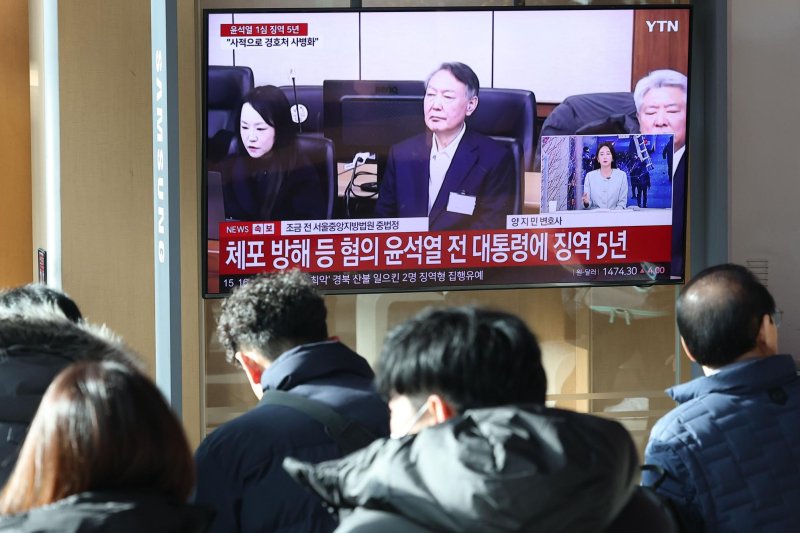
UPDATE: Former President Yoon Suk Yeol has been sentenced to five years in prison for obstructing justice, a decision announced today by the Seoul Central District Court. This groundbreaking ruling comes amid ongoing investigations into Yoon’s controversial imposition of martial law in December 2024.
The verdict, delivered earlier today, is the first in a series of charges against Yoon, who was accused of blocking investigators’ attempts to detain him in January 2023. This sentence is notably half of the 10 years requested by special counsel Cho Eun-suk, who labeled Yoon’s actions as a “grave crime” aimed at privatizing state institutions to conceal his illegal activities.
During a live televised hearing, Judge Baek Dae-hyun outlined the numerous charges against Yoon, including directing the Presidential Security Service to obstruct the execution of a warrant, violating the rights of nine Cabinet members by failing to convene them regarding his martial law decree, and later destroying critical documents. Yoon also faced accusations of distributing misleading press statements and deleting records from secure military phones.
The court found Yoon guilty of all charges, except for those related to two Cabinet members’ rights and the issuance of false statements. Judge Baek emphasized that Yoon displayed no remorse for his actions, which he described as having “very bad” implications.
This ruling is expected to significantly impact the upcoming verdict on February 19, 2024, regarding allegations of insurrection related to Yoon’s martial law decree. Special prosecutors have notably requested the death penalty for Yoon in this case, underscoring the gravity of the situation.
Yoon currently faces a total of eight trials that include serious allegations tied to the martial law attempt, corruption involving his spouse, and the 2023 death of a Marine. This marks the third instance of a former South Korean president’s trial being broadcast live, following the cases of former Presidents Park Geun-hye and Lee Myung-bak.
As this case unfolds, the implications for South Korean politics remain profound, with potential shifts in public sentiment and governance on the horizon. Authorities are closely monitoring the situation, and updates will follow as they develop.