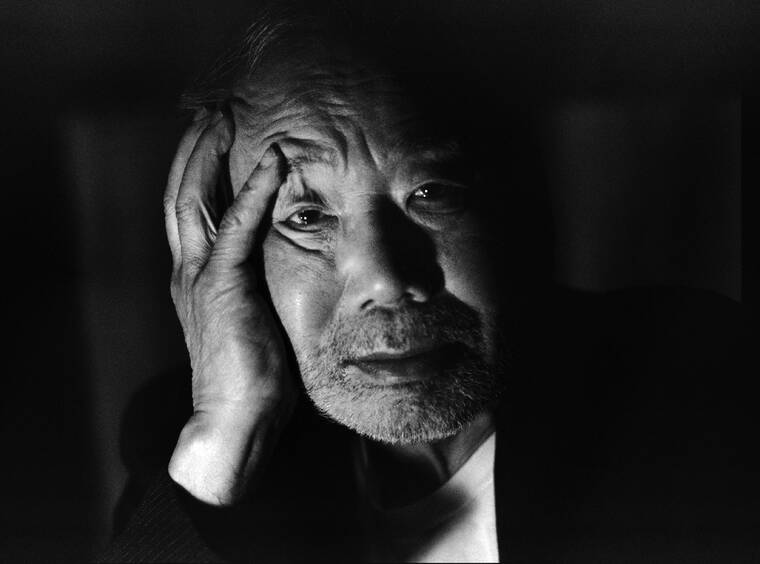
When renowned Japanese author Haruki Murakami sits down to write, he embraces uncertainty. Despite being a global literary figure with over 40 published works and millions of copies sold worldwide, Murakami admits that he has no clear plan when he writes. “I don’t have any plan. I’m just writing, and while I’m writing, strange things happen very naturally,” he stated during a recent interview in New York. This creative process, which he describes as entering another world, allows him to explore his subconscious and then translate those experiences into his work.
The interview took place in a quiet underground cocktail lounge in a Manhattan hotel, an environment that mirrored the themes of caves and tunnels prevalent in his writing. Dressed casually, Murakami spoke with a measured calmness, revealing his tendency to shy away from public appearances. “I’m not good at socialization,” he confessed, noting that he usually prefers solitude and hard work.
On December 11, 2023, Murakami addressed a packed audience at Town Hall, discussing the globalization of Japanese literature, a phenomenon he has significantly influenced. Earlier that week, he accepted a lifetime achievement award from the Center for Fiction, presented by musician and writer Patti Smith. During his speech, he reflected on his early career, recalling a book signing in the United States that drew only a handful of attendees. “I remember sitting with a pen in my hand and nothing to do,” he recounted, highlighting the stark contrast to his current popularity.
Murakami’s works have garnered immense acclaim, with his novels celebrated through midnight release parties and devoted fan engagements. In the United States alone, he has sold over 6 million copies. This fall, his latest short work, “Abandoning a Cat,” will be released by Knopf, offering insights into his relationship with his father. Additionally, a book focusing on his classical music collection is set for publication next year, alongside reissues of his earlier titles.
At the age of 77, Murakami continues to produce new material. He has recently completed a novel, which is scheduled for release in Japan this summer, and will be translated into English. Much of this work was penned after he recovered from a serious illness that required a month-long hospitalization. “It’s kind of a resurrection,” he remarked, expressing relief that his desire to write returned post-recovery. This forthcoming novel represents a departure from his previous themes, as it is primarily narrated from a woman’s perspective. Despite past criticisms regarding his portrayal of female characters, he found this new approach both challenging and natural. “I became her,” he said, indicating a deeper connection to the narrative.
Murakami’s journey to becoming a writer was not straightforward. Growing up as the only child of two teachers in the suburbs of Kobe and Osaka, he initially aspired to be a musician but struggled to commit to practice. His early academic experience was marked by indifference, particularly towards Japanese literature. Instead, he gravitated towards American authors like Ernest Hemingway and F. Scott Fitzgerald, as well as Russian classics such as Fyodor Dostoyevsky‘s works.
His passion for music has had a profound influence on his writing style. Before finding his voice as a novelist, he ran a jazz club in Tokyo. It was during a baseball game that he spontaneously decided to write a novel, initially drafting it in English to clarify his thoughts. This method helped him refine his unique style, which emphasizes simplicity and rhythm.
Murakami’s first novel, “Hear the Wind Sing,” won a literary prize and was published in Japan in 1979. His international reputation soared with the English translation of “A Wild Sheep Chase” in the early 1980s, yet he faced criticism at home for being too influenced by Western literature. As he relocated to Europe and the United States, he distanced himself from the negative feedback.
Now, he reflects on his evolution as a writer and the changing perceptions within Japan. “I got older, and people respect old men,” he noted, finding validation in his later years. Murakami maintains a disciplined daily routine that includes early mornings dedicated to writing, alongside household chores and running. He expressed a desire to continue exploring the depths of his creativity, stating, “I’m feeling I’ll be able to do more, because writing fiction is so wonderful. Even when I got old, there’s still space to explore.”
As Murakami continues to inspire readers with his imaginative storytelling, his commitment to his craft remains unwavering, demonstrating that the journey of writing is as vital as the stories he creates.