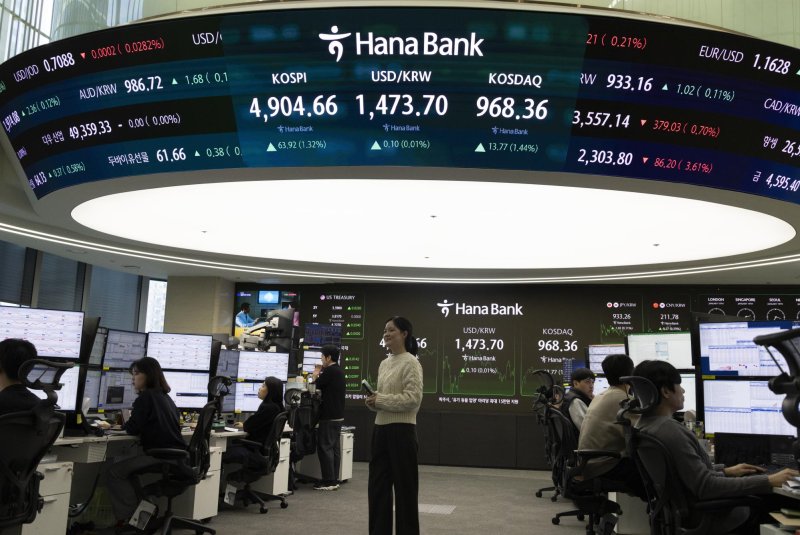
URGENT UPDATE: Major shifts in South Korea’s financial landscape are underway as investors withdraw a staggering 35.4 trillion won ($23.9 billion) from the nation’s top five banks, triggered by a robust rally in the KOSPI index. As of January 20, deposit data reveals a concerning 4.99% drop in demand deposits, raising alarms within the banking sector.
The five leading banks—KB Kookmin Bank, Shinhan Bank, Hana Bank, Woori Bank, and NH Nonghyup Bank—report that total demand deposits have fallen to 673.9 trillion won ($455.6 billion). Time deposits also saw a slight decline, dropping to 938.3 trillion won ($634.3 billion) from 939.3 trillion won ($635.0 billion) in December.
Market analysts attribute this significant outflow to a strategic pivot towards securities-related cash. Investor deposits surged to 91.2 trillion won ($61.7 billion) as of last Friday, a remarkable increase from 77.9 trillion won ($52.7 billion) at the end of November. Additionally, cash management account balances rose to 103.0 trillion won ($69.6 billion), up from 98.1 trillion won ($66.3 billion) during the same timeframe.
The KOSPI’s remarkable ascent has been directly linked to these rising investor deposits. Just last June, deposits were around 60 trillion won ($40.6 billion) when the index hovered near 2,000. By October 13, this number surpassed 80 trillion won ($54.1 billion), and as the index continued its upward trajectory in January, deposits climbed above 90 trillion won ($60.8 billion), reaching 92.9 trillion won ($62.8 billion) on January 8.
In response to these developments, banks have reintroduced deposit products offering interest rates in the 3% range. However, they face fierce competition from newly launched integrated investment accounts (IMAs) that promise principal protection along with potential returns exceeding 4%. On its first day, one IMA product attracted 220 billion won ($149 million) in investments, signaling strong market interest.
An official from the banking sector commented, “The return of 3% deposit products reflects our efforts to address the ongoing money move.” While the decline in time deposits remains modest, banks are closely monitoring these trends for further developments.
As the KOSPI continues to gain momentum, the implications of these financial shifts will be critical for both investors and the broader economy. Stay tuned for more updates as the situation unfolds.