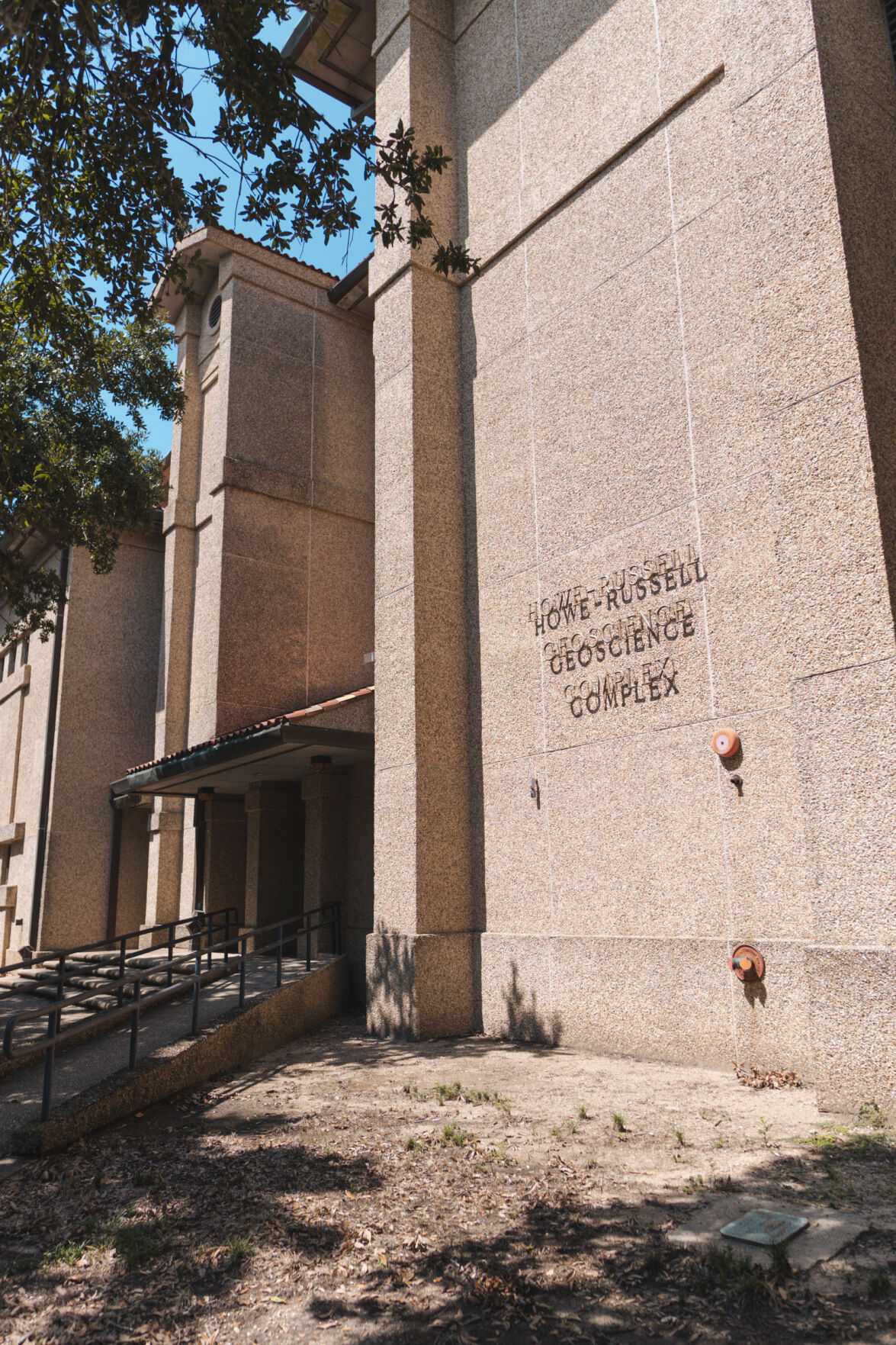
BREAKING: LSU researchers have just announced a transformative upgrade to the university’s scanning electron microscope, a move that significantly enhances geological research capabilities. Researchers Brandon Shuck and Erini Poulaki secured $26,000 to implement advanced AZtec software, enabling unprecedented data collection on mineral samples.
This upgrade is vital for the geology department at Louisiana State University, allowing researchers to analyze complex mineral structures with greater precision. The software enhances the microscope’s performance in collecting essential Energy-Dispersive X-ray Spectroscopy (EDS) and Electron Backscatter Diffraction (EBSD) data, crucial for understanding mineral composition and orientation.
“Our upgraded capabilities mean we can now produce detailed maps of heterogeneous minerals that were impossible to obtain before,” said Poulaki. She emphasized that while the hardware remains unchanged, the software enhancement opens doors to new research possibilities.
Previously, the microscope was primarily used by engineering departments focused on homogeneous metals. However, the geology team needed a more effective way to analyze the spatial extent of various minerals within their samples. “The upgrade allows us to work on much larger areas, which is critical for our research,” Shuck explained.
The path to securing funding was challenging. Initially, the researchers approached Oxford Instruments, the software’s manufacturer, under the assumption the cost would be manageable. They quickly discovered that the price reflected the software’s advanced capabilities. Shuck had to draft a proposal to the LSU Board of Regents, advocating for funds from the equipment repair budget to cover the majority of the costs.
Without this upgrade, researchers faced a daunting task of manually analyzing data for up to 24 hours, stitching together results that often proved ineffective. Now, the microscope can automate this process, providing clean, processed maps in a fraction of the time.
“This investment marks a significant shift for our department,” Shuck stated. “What was once a specialized tool with limited applications is now a pivotal instrument for daily research.”
The upgrade not only enhances LSU’s research capabilities but also showcases the university’s commitment to advancing scientific inquiry. The geology department is now better equipped to tackle complex geological challenges, further solidifying LSU’s position in the field of geoscience.
As this upgrade unfolds, both Shuck and Poulaki are eager to share access to the microscope with other departments, fostering interdisciplinary collaboration. The implications for ongoing and future geological research are profound, with LSU leading the charge in innovative scientific exploration.
Stay tuned for more updates as LSU continues to expand its research capabilities and push the boundaries of geological science.