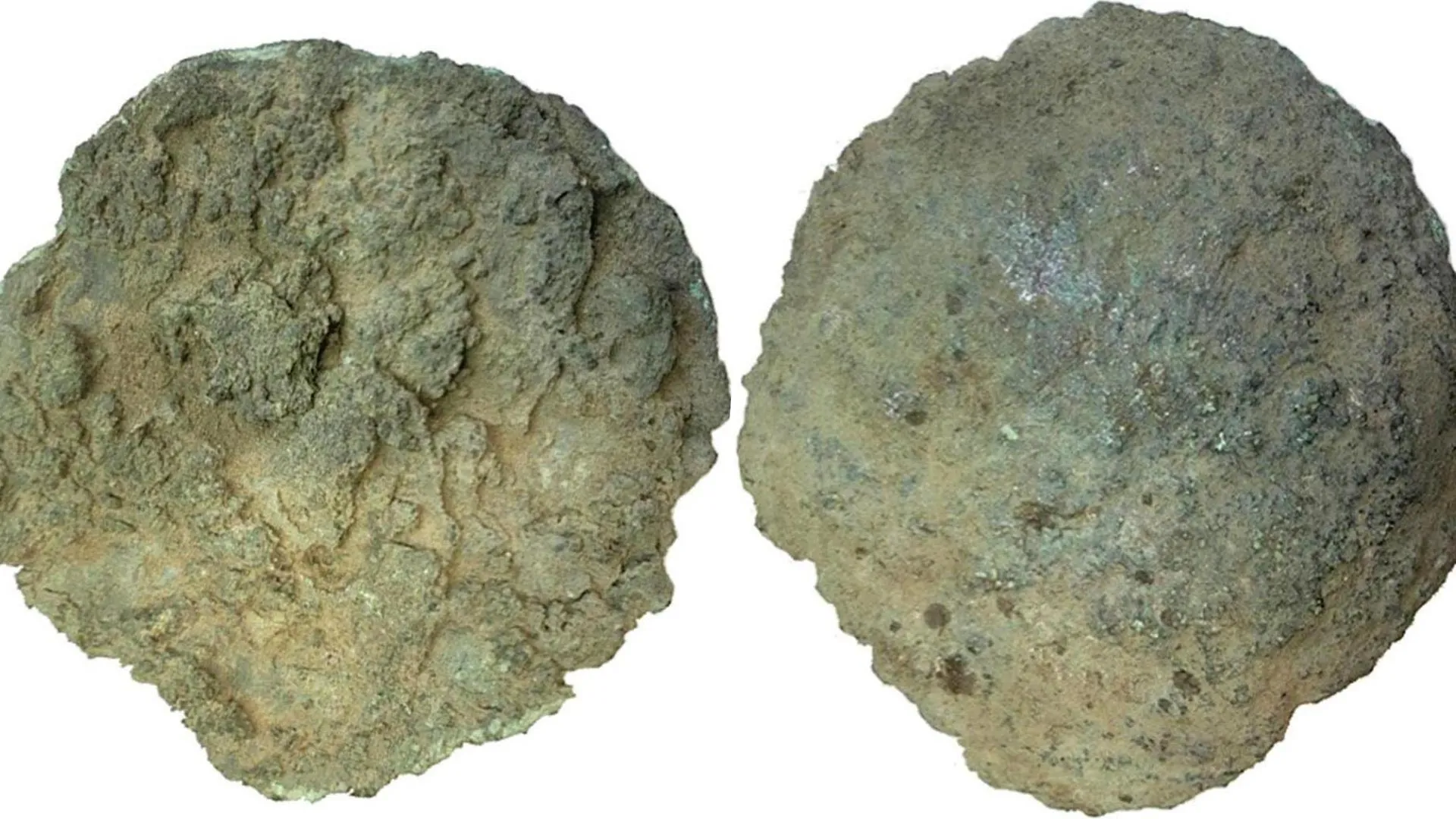
UPDATE: A groundbreaking discovery in Sweden is shaking up our understanding of Iron Age history. Researchers at the University of Gothenburg have confirmed that a mysterious plano-convex ingot, initially believed to be from the Bronze Age, actually dates back to the Iron Age. This revelation was made public on November 23, 2025, following extensive chemical and isotopic analysis.
The Särdal ingot, uncovered for the first time in Sweden, displayed a composition that closely resembles Iron Age artifacts found in Poland. This unexpected connection opens new avenues for understanding ancient trade and interactions across the Baltic region. The findings underscore how modern scientific techniques can unveil significant historical narratives from solitary artifacts.
“This ingot was initially thought to be a Bronze Age relic due to its shape and size,” said Serena Sabatini, a leading researcher in the study. “However, our analysis revealed it to be made of a copper-zinc-tin-lead alloy typical of the Iron Age.” Such plano-convex ingots have historically been used for transporting metal across Europe, making this discovery pivotal for understanding the movement of goods in ancient times.
Initially, archaeologists assumed the Särdal ingot belonged to the Bronze Age, largely because it was found alone without contextual materials. To clarify its origins, researchers turned to scientific testing, which ultimately overturned their initial assumptions. The ingot’s unique composition aligns with known Iron Age metallurgy, suggesting a previously underestimated level of interaction between regions.
The collaboration between the research team and Polish scholars has been instrumental in this discovery. “Thanks to our teamwork, we were able to link our ingot with similar finds in Poland, illustrating a broader network of trade and cultural exchange,” Sabatini stated. This case exemplifies how isolated artifacts can gain significant historical context when analyzed and compared with similar materials from other regions.
Employing established techniques in archaeometallurgy, including lead isotope and trace element analyses, the team shed light on the ingot’s origins and geological context. “What sets this study apart is our ability to integrate scientific data with historical information, providing a more comprehensive narrative about the Särdal ingot and its connections to artifacts from northeastern Poland,” explained Sabatini.
This discovery has significant implications, not just for Sweden and Poland, but for our understanding of the Iron Age across Europe. The findings, published in the Journal of Archaeological Science, emphasize the importance of international collaboration in archaeology, as shared knowledge can lead to breakthroughs that would otherwise remain hidden.
As researchers continue to analyze the Särdal ingot and its implications for Iron Age connections, the world watches closely. This remarkable find not only challenges existing narratives but also encourages scholars to explore the vast networks that may have existed long before written history.
Stay tuned for further updates on this developing story as experts unravel the mysteries of our ancient past.