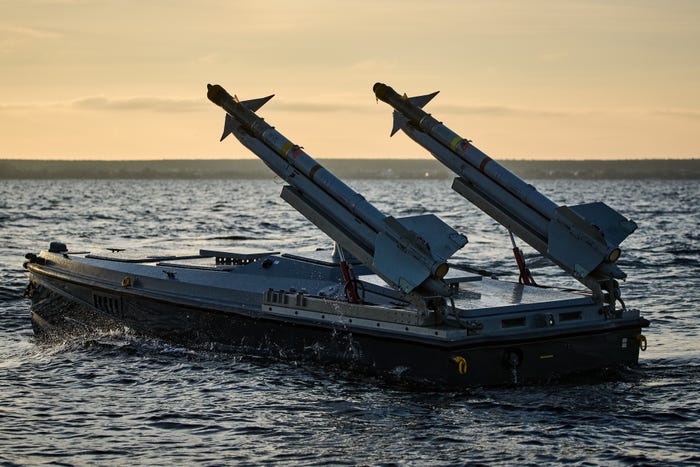
UPDATE: Russian helicopters are now avoiding operations near Ukraine’s naval drones, which have evolved into formidable threats, a Ukrainian special forces commander revealed. The commander, known as Thirteen, stated that these drones have become “easy targets” for missile attacks, forcing Russia to rethink its aerial strategies.
This significant shift comes as Ukraine’s naval drones, particularly the advanced Magura V7, have been armed with missiles capable of taking down Russian aircraft. Thirteen, leading “Group 13” within Ukraine’s defense intelligence agency (GUR), shared these insights during a recent showcase, reported by Ukrainian outlet Pravda.
The commander explained that Russian helicopters previously posed a “critical threat” to Ukrainian operations. However, with the enhancement of naval drones to include missiles, Russian forces have ceased their helicopter deployments in areas where these drones operate. “After that, the enemy stopped using helicopters against us altogether,” Thirteen stated.
This development underscores a pivotal moment in the ongoing conflict, as Ukraine’s naval drones have not only achieved notable victories against Russian warships but are now successfully driving away Russian air patrols. Earlier reports indicate that Ukraine recorded its first-ever naval drone kill of a Russian helicopter in December 2022, when a Magura V5 destroyed a Russian Mi-8 helicopter with missiles.
The implications of this strategy are profound. Russia’s reliance on helicopters has diminished due to their increasing vulnerability amidst the evolving battlefield dynamics, where both sides grapple for aerial dominance. The shifting effectiveness of these helicopters has been stark, as they were once instrumental for Russia in conducting troop transport, logistical support, and armed assaults.
Despite suffering losses, Russian helicopters have been employed cautiously throughout the conflict. They have played various roles including drone hunting and support missions, yet their operational scope is now limited by the advanced capabilities of Ukrainian naval drones. These drones have transitioned from being primarily explosive-laden craft to versatile systems capable of targeting a wide range of aerial threats.
The development of Ukraine’s naval drone technology is rapidly changing the maritime landscape of the conflict. Alongside their aerial counterparts, these naval drones are compelling Russian forces to withdraw their naval fleet, previously stationed in Sevastopol, further into the safety of Novorossiysk. This strategic retreat reflects Ukraine’s growing naval prowess despite lacking a traditional navy.
The evolution of these drones is not just a technological advancement; it is a testament to Ukraine’s resilience and adaptability in the face of aggression. The ongoing enhancements—including the addition of missile and rocket launchers—are pivotal in blunting Russia’s naval and aerial capabilities.
As the situation develops, all eyes remain on the impact of Ukraine’s naval drones. The ability to shoot down helicopters illustrates a significant shift in the balance of power in the skies and at sea. Observers worldwide are watching closely as Ukraine continues to innovate and adapt its military strategies, making it imperative for both sides to reassess their operational tactics.
This update marks a crucial point in the conflict, with Ukraine’s naval drones setting the stage for a new phase in aerial warfare. The implications of these developments resonate beyond the battlefield, shaping the future of military engagements in the region.