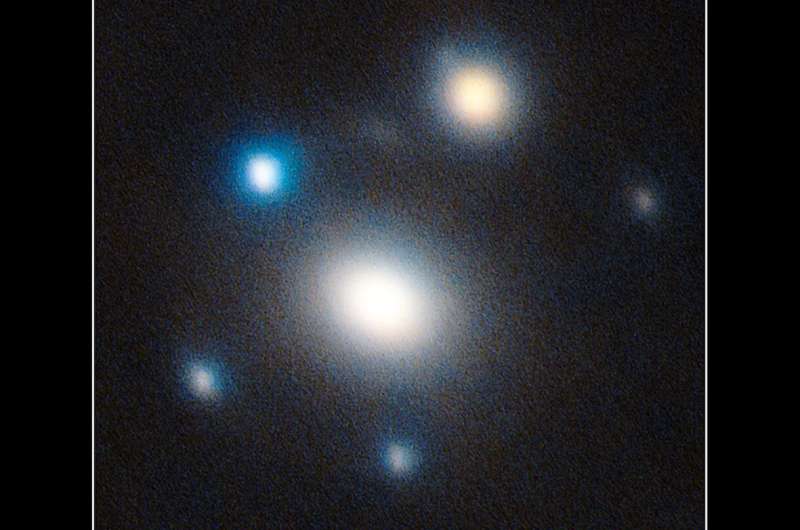
A research team has identified a rare supernova, named SN Winny, which may provide a groundbreaking method to measure the rate of the universe’s expansion. This discovery, made by scientists from the Technical University of Munich, Ludwig Maximilians University, and the Max Planck Institutes, has the potential to clarify ongoing debates surrounding the Hubble constant, the value that indicates how quickly galaxies are receding from each other.
The universe’s expansion has been a known phenomenon for nearly a century, yet precise measurements of its rate remain contentious. The findings regarding SN Winny were published on the arXiv preprint server and detail a superluminous supernova located approximately 10 billion light-years away. What makes this supernova particularly unique is that it appears five times in the night sky, a result of gravitational lensing caused by two foreground galaxies that bend its light.
By observing the time delays between the multiple images of SN Winny, researchers aim to directly calculate the universe’s current expansion rate. Sherry Suyu, an Associate Professor of Observational Cosmology at TUM, remarked, “The chance of finding a superluminous supernova perfectly aligned with a suitable gravitational lens is lower than one in a million. We spent six years searching for such an event.”
Significance of Gravitational Lensing
Gravitational lensing occurs when massive objects, such as galaxies, bend light from distant sources. The unique alignment of SN Winny allowed researchers to capture high-resolution images using the Large Binocular Telescope in Arizona, USA. This observation produced the first detailed color image of the supernova’s system, showcasing both the lens galaxies and the five images of the supernova, which resemble cosmic fireworks.
The simplicity of this lensing system presents an exciting opportunity for accurate measurements. The team, including junior researchers Allan Schweinfurth and Leon Ecker, developed a model for the mass distribution of the lensing galaxies. Schweinfurth explained, “SN Winny is lensed by just two individual galaxies. The overall simplicity of the system offers an exciting opportunity to measure the universe’s expansion rate with high accuracy.”
Resolving the Hubble Tension
Current methods for measuring the Hubble constant yield conflicting results, a dilemma known as the Hubble tension. Traditionally, scientists have relied on two primary techniques: the local method and the cosmic microwave background method. The local method, often compared to climbing a ladder, builds distance measurements incrementally, while the cosmic microwave background approach examines the universe’s early moments. Each method has its limitations, leading to discrepancies in the calculated values of the Hubble constant.
The approach utilizing SN Winny offers a novel, one-step method that could resolve these discrepancies. Stefan Taubenberger, a key member of Suyu’s team, noted, “By measuring the time delays and knowing the mass distribution of the lensing galaxy, we can directly calculate the Hubble constant. This method minimizes the sources of systematic uncertainties.”
As astronomers around the world continue to observe SN Winny with various telescopes, the results are anticipated to provide crucial insights into the ongoing Hubble tension, potentially reshaping our understanding of the cosmos. The research team is optimistic that their findings will clarify the mysteries surrounding the universe’s expansion and its implications for cosmology as a whole.