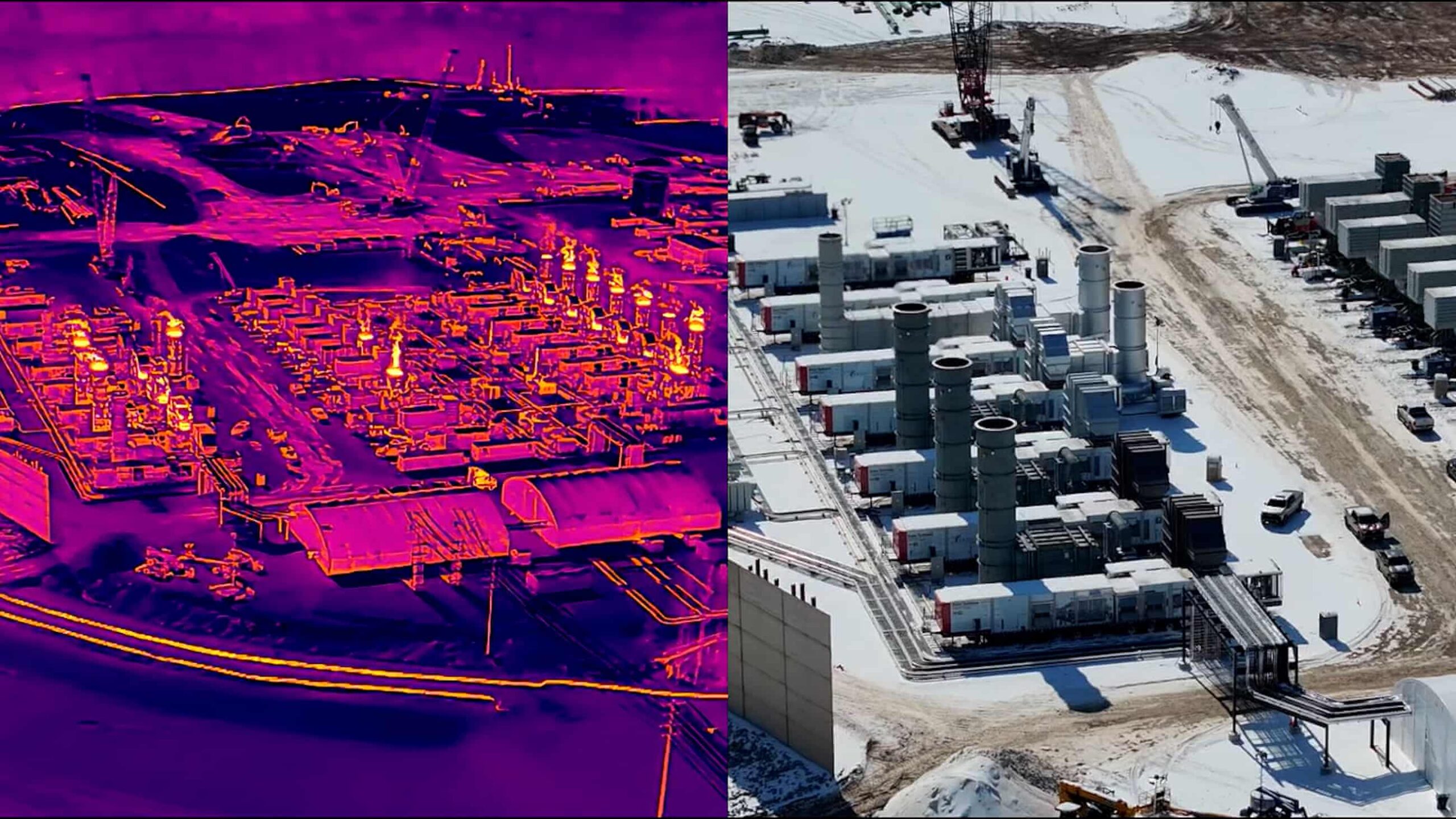
Elon Musk’s artificial intelligence firm, xAI, is under scrutiny for allegedly operating unpermitted gas turbines at its facility in Southaven, Mississippi. An investigation by the non-profit newsroom Floodlight reveals that thermal drone footage captured by the organization shows xAI continuing to burn gas despite a recent ruling from the Environmental Protection Agency (EPA) stating that such activities require a state permit.
The EPA has long maintained that any sources of pollution, including gas turbines, must be permitted under the Clean Air Act. In a ruling announced on January 15, 2024, the agency emphasized the necessity of obtaining permission prior to operation. Despite this, state regulators in Mississippi argue that the turbines, which are mounted on tractor trailers, do not require permits. According to the EPA, any exemption for these machines could result in the absence of emission standards entirely.
Floodlight’s thermal images, assessed by multiple experts, indicate that over a dozen unpermitted turbines are still emitting pollutants at the facility nearly two weeks after the EPA’s ruling. Bruce Buckheit, a former EPA air enforcement chief, stated, “That is a violation of the law. You’re supposed to get permission first.” xAI has sought permits for additional turbines in Southaven but has not responded to requests for comment.
The EPA has initiated a record-low number of enforcement actions in recent years and has not addressed questions regarding the turbines at Musk’s facilities, instead deferring to local authorities. A public hearing on the matter is scheduled for February 17, 2024, with the public comment period still open.
As datacenters proliferate across the United States, regulators struggle to keep pace with the industry’s increasing reliance on custom-built or ad hoc power sources, raising concerns about their public health impacts. Southaven exemplifies this issue, where local and federal guidance appears to be at odds. The turbines in question are crucial for powering Grok, xAI’s controversial chatbot, which emits harmful pollutants associated with health issues such as asthma, lung cancer, and heart attacks.
Concerns regarding noise and pollution have been voiced by Southaven residents, particularly given the proximity of at least ten schools within a two-mile radius of the facility. Longtime resident Shannon Samsa remarked, “For them to be releasing so much pollution in such a populated area… is really concerning.” She added, “It’s horrifying to me that we’re allowing this in our community.”
Regulatory Conflicts and Community Health Risks
The turbine cluster in Southaven is part of xAI’s expanding operations along the Tennessee-Mississippi border. This expansion began in Spring 2024 in South Memphis, where xAI constructed Colossus 1, promoted as the world’s largest AI supercomputer. In April, the Southern Environmental Law Center (SELC) revealed that xAI had been operating over 30 unpermitted gas-powered turbines at that site.
Despite the EPA’s clear guidelines, county officials in Tennessee claimed that the turbines did not require permits. In July 2024, amid local opposition, the county permitted 15 turbines for use at the Colossus 1 site. By January 2024, the EPA reiterated that such machinery needs a permit. By this time, xAI had already established a second datacenter, Colossus 2, which relies on 27 turbines stationed in Southaven.
Experts, including Buckheit, have expressed concern about the lack of regulatory action. “One might easily have expected… at least a stop-work order [from the EPA],” he noted, adding that the EPA could refer the case to the Department of Justice, though this has yet to occur. An EPA spokesperson redirected questions about enforcement options to state or local air permitting authorities, while the Mississippi Department of Environmental Quality maintains that the turbines are categorized as portable units and therefore exempt from permitting during this temporary period.
Local residents like Krystal Polk have expressed frustration over the situation. Polk, who has asthma, noted the drastic changes in her once-peaceful neighborhood, now filled with noise and pollution. “I do feel like xAI is playing by a different set of rules,” she said. Her family’s home, a longtime residence, has become untenable due to health concerns, leading her to reconsider her plans for retirement in Southaven.
Growing Environmental Concerns Amid AI Expansion
The expansion of datacenters, including xAI’s operations, raises critical questions about the sustainability of their energy sources. Despite industry leaders’ claims of pursuing sustainability, a significant portion of datacenter energy—approximately 75%—is derived from fossil fuels. A recent report by Cleanview indicates that while many projects reference renewable energy, significant implementation is not expected until after 2028.
As xAI seeks to expand its operations in Southaven, it has applied for a permit to operate 41 turbines, which could produce over 6 million tons of greenhouse gases and more than 1,300 tons of harmful air pollutants annually. This would potentially position it as one of the largest fossil fuel power plants in Mississippi.
Samsa, who has rallied community support for a petition demanding the closure of the plant, reflects the widespread sentiment among residents. “I don’t want my children to be growing up around such massive amounts of air pollution,” she stated. “I don’t want them to live in a place where their health and their overall well-being is not considered over economics.”
Floodlight’s investigation highlights the ongoing tension between technological advancement and environmental responsibility, as well as the urgent need for effective regulation in the face of rapid industry growth. The situation in Southaven serves as a critical case study in the intersection of community health, corporate expansion, and regulatory frameworks.