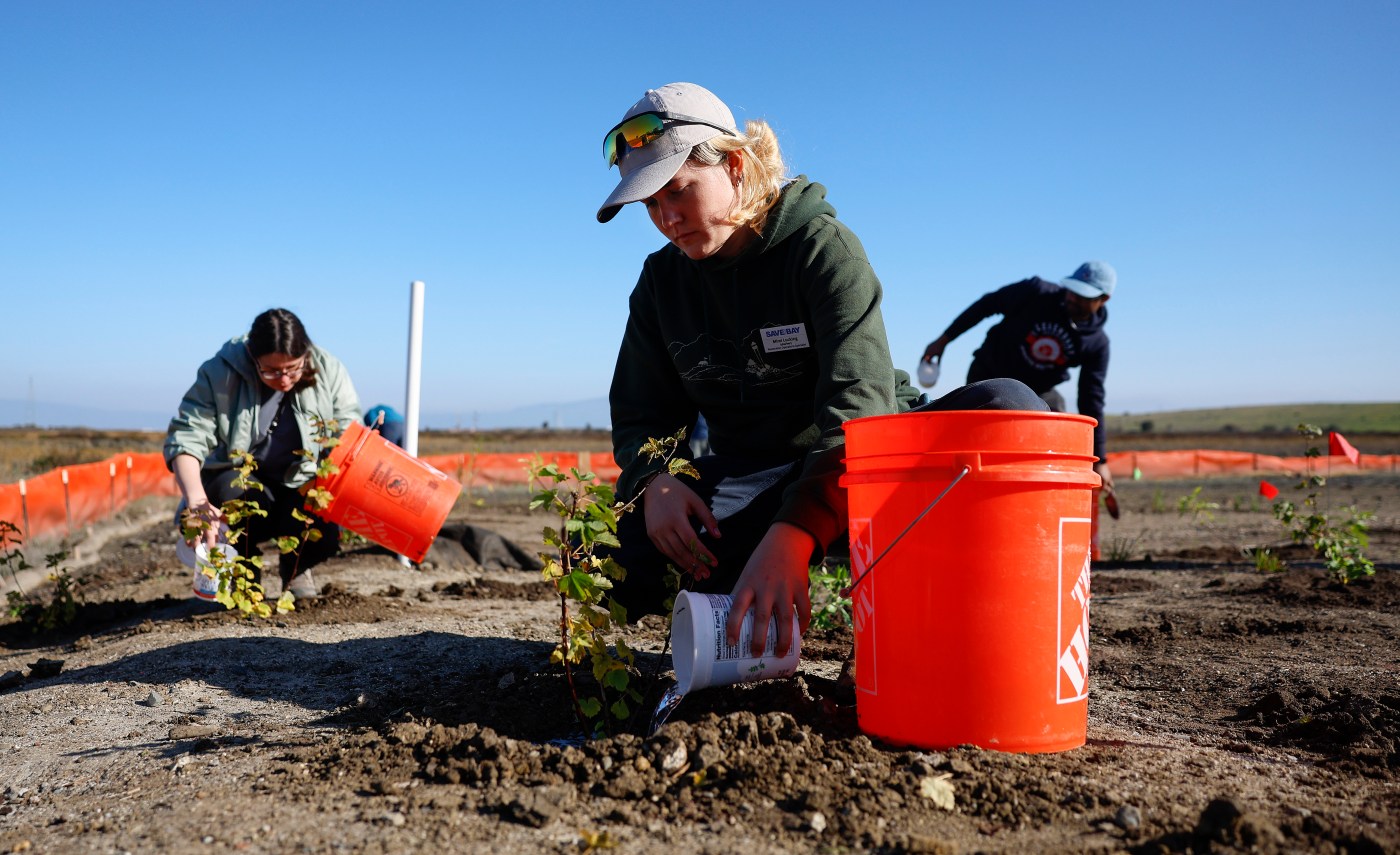
UPDATE: Volunteers gathered early this morning, December 10, 2025, at the Palo Alto Baylands to kick off an innovative project aimed at combating flooding and climate change threats. The initiative marks the launch of the Bay Area’s first horizontal “living levee,” a nature-based solution designed to absorb storm surges and enhance shoreline resilience.
This pioneering project utilizes treated wastewater to support native plant growth along the coastline, forming a critical buffer against rising sea levels. Approximately 35 volunteers joined the effort, planting species like black elderberry and marsh baccharis. Another volunteer day is already scheduled for Saturday morning, demonstrating community commitment to environmental sustainability.
Jessie Olsen from Save the Bay stated that this is just the first step in a multi-phase project, with plants expected to reach maturity by the end of 2026. “These in-person experiences help introduce vital concepts like nature-based solutions,” Olsen emphasized during a media tour.
Officials are heralding this project as a groundbreaking fusion of wastewater reuse and habitat restoration. Karin North, assistant director of Public Works for Palo Alto, noted, “This project is unique on the San Francisco Bay shoreline,” referencing its innovative approach that irrigates native plants with treated water.
The project, costing nearly $7 million—including $4.8 million for construction—was launched in partnership with various organizations, including Environmental Science Associates and U.S. Geological Survey. The Palo Alto treatment facility, which processes 20 million gallons of wastewater daily for over 230,000 residents, is undergoing $369 million in upgrades to enhance water quality and prevent harmful algal blooms.
Unlike traditional concrete levees, this “living levee” employs vegetation to naturally absorb storm impacts and reduce flooding risks. Samantha Engelage, a senior engineer, highlighted the dual benefits of the levee: enhancing flood protection while providing essential habitat for local wildlife.
The urgency of this initiative cannot be overstated. Climate models predict sea levels could rise between 3 to 10 feet by 2100, threatening both shoreline communities and infrastructure. The city’s climate assessment warns that without adaptive measures, essential services may be inundated.
Engelage hopes this project will serve as a model for larger-scale shoreline protection efforts, stating, “While we know a larger project is needed, we aim to learn from this to inform future designs.” Similar projects are being developed across the Bay Area, fostering innovative uses for wastewater.
As the community comes together to plant these vital native species, the project not only addresses immediate flooding concerns but also promotes environmental stewardship and resilience. Heidi Nutters from the San Francisco Estuary Partnership remarked, “Thinking about a horizontal levee encourages us to view wastewater as a resource rather than waste.”
Stay tuned for more updates as this significant environmental project unfolds, showcasing how local initiatives can combat global climate challenges.