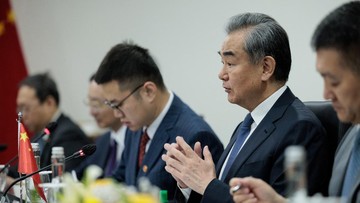
Wang Yi, China’s Foreign Minister, has publicly condemned the ongoing conflict in the Middle East, calling for the United States to take responsibility in managing differences that contribute to rising tensions. This statement comes amid escalating diplomatic strains between China and the United States, highlighting the need for constructive dialogue.
During a recent press conference held on September 25, 2023, Wang Yi emphasized the importance of fostering peace in the region. He pointed out that the conflict not only threatens the stability of the Middle East but also has broader implications for global security. “Peace and stability in the Middle East are not only crucial for the region itself but also for the world,” he stated, urging the international community to prioritize dialogue over confrontation.
Wang’s remarks are particularly significant given the backdrop of increasing military posturing and political disagreements between Washington and Beijing. The ongoing disputes encompass various issues from trade to human rights, and the Middle East conflict adds another layer of complexity to their relationship.
In his address, Wang reiterated that the United States, as a major global power, has a unique responsibility to mediate differences effectively. He criticized the current approach, suggesting that it has exacerbated tensions rather than alleviating them. “The world is watching, and it is imperative for the US to adopt a more responsible and constructive role,” he added.
China’s position on the Middle East also reflects its broader foreign policy goals. As it seeks to enhance its influence in global affairs, promoting peace and stability in conflict-prone areas aligns with its interests in economic development and international cooperation.
The call for US intervention is not merely a diplomatic stance; it underscores China’s desire to be seen as a key player in global peace initiatives. Beijing has been increasing its engagement in international fora, often positioning itself as a counterbalance to US influence.
The Middle East has been a focal point of international conflict for decades, and the repercussions of instability in this region extend far beyond its borders. Wang’s assertion is a reminder that the responsibility for global peace does not rest solely with any one nation, but rather requires a concerted effort from multiple stakeholders.
Moving forward, the effectiveness of Wang Yi’s call for the US to manage its differences with China may hinge on both nations’ willingness to engage in meaningful dialogue. As tensions continue to simmer, the international community will be looking closely at how these two influential powers navigate their complex relationship in the context of global peace efforts.
In conclusion, Wang Yi’s condemnation of the Middle East warfare and his appeal to the United States marks a significant moment in international relations, reflecting broader geopolitical dynamics at play. The outcome of this diplomatic engagement could have lasting implications for both regional stability and international cooperation in addressing global challenges.