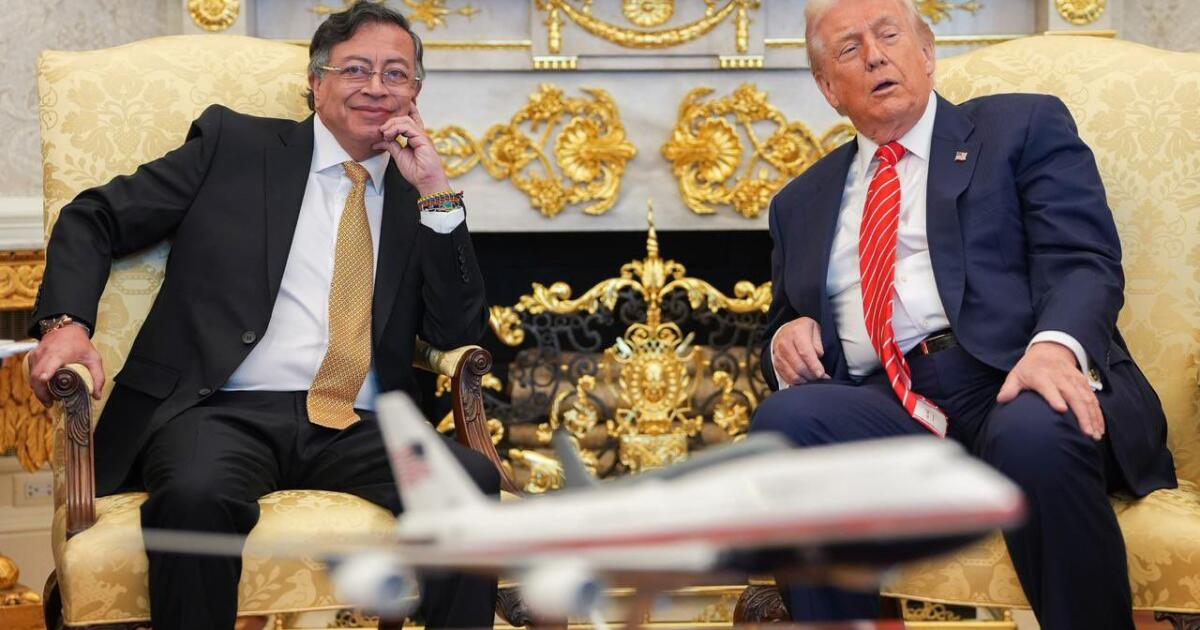
Tensions between Colombian President Gustavo Petro and U.S. President Donald Trump have eased following a recent meeting at the White House. The two leaders, who have exchanged harsh words over the past year, described their closed-door discussions as productive. The two-hour meeting on January 7, 2024, covered various topics, including energy, Venezuela, and joint efforts to combat drug trafficking.
Trump characterized the meeting as “fantastic,” while Petro referred to it as having an “optimistic and constructive tone.” In a gesture of goodwill, Petro presented Trump with Colombian coffee and a gown made by indigenous artisans for First Lady Melania Trump. In return, Trump gifted Petro a framed portrait of their handshake, inscribed with the words: “I love Colombia.”
The meeting did not resolve the significant political differences between the two leaders. Trump advocates for a strong U.S. presence in the Western Hemisphere, while Petro, a former left-wing guerrilla, has criticized U.S. operations in Venezuela, particularly the capture of President Nicolás Maduro. Despite these differences, the dialogue marks a potential thaw in relations between Colombia and the United States, a partnership that had soured over the previous year.
Relations had become strained after Trump resumed office for a second term. Tensions escalated when Petro initially refused to allow U.S. military flights to deport migrants from Colombia. Following heavy threats of tariffs on Colombian imports, Petro acquiesced. The situation further deteriorated after Petro’s speech at the United Nations General Assembly, where he condemned U.S. support for Israel and called for American soldiers to prioritize humanitarian orders over Trump’s directives. This prompted the U.S. State Department to revoke the visas of Petro and several family members.
In the months leading up to the meeting, Trump directly accused Petro of failing to curb cocaine production, even alleging that Petro himself was involved in drug trafficking. As a result, Washington rescinded Colombia’s certification for effective cocaine crop elimination and suspended aid, which totaled more than $740 million in 2023. The Colombian government responded by recalling its ambassador to the United States.
The situation escalated dramatically following a U.S. operation that resulted in the bombing of Caracas and the capture of Maduro. Petro condemned the actions as “kidnapping” and publicly challenged Trump, suggesting that he was ready for a similar military strike in Colombia. Trump did not rule out the possibility of military action, stating, “It sounds good to me.”
Despite their contentious history, the January 7 phone call between the two leaders set the stage for the White House meeting. The U.S. granted Petro a temporary visa to facilitate his visit. Colombian officials reported that Petro aimed to highlight his administration’s efforts in combating drug trafficking, despite the rising cocaine production in Colombia. Acting Minister of Justice Andrés Idárraga Franco noted that Petro’s administration has extradited more criminals to the United States than any of his conservative predecessors, including a notable alleged trafficker handed over to U.S. authorities just this week.
While typically reporters are permitted to ask questions during meetings between Trump and foreign leaders, this was not the case on this occasion. Following the meeting, Trump acknowledged their rocky relationship, stating, “You know, he and I weren’t exactly the best of friends.” He emphasized that he was not insulted during their interactions, as he was unfamiliar with Petro prior to their discussions.
Speaking to journalists at the Colombian Embassy in Washington after their meeting, Petro addressed a range of issues. He reiterated his concerns about climate change, criticized U.S. military operations in Venezuela, and highlighted what he termed the “genocide” in Gaza. In a light-hearted moment, he mentioned that Trump gave him one of his signature red baseball caps. Petro humorously altered Trump’s slogan, adding an “s” to create “Make Americas Great Again.”
The meeting marks a significant moment in the evolving relationship between Colombia and the United States, suggesting a potential path toward improved diplomatic ties despite underlying tensions and disagreements.