U.S. futures and global shares experienced a downturn on Monday due to rising concerns surrounding President Donald Trump’s nominee for the Federal Reserve chair and the potential for a bubble in the artificial intelligence sector. The situation has heightened investor anxiety, leading to significant market fluctuations.
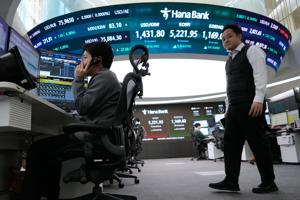
Trading on South Korea’s exchange was temporarily suspended as its benchmark Kospi index fell sharply, closing down 5.3% at 4,949.67. Major tech companies such as Samsung Electronics and SK Hynix were notably impacted; Samsung saw a decline of 6.3%, while SK Hynix plummeted 8.7%. Recently, the Kospi had been reaching record highs, fueled by substantial investments in AI technologies and partnerships with influential companies like chip maker Nvidia and OpenAI.
In early European trading, the sentiment mirrored that of global markets. Germany’s DAX index edged down less than 0.1% to 24,528.57, while the CAC 40 in Paris decreased by 0.2% to 8,108.56. The FTSE 100 in Britain fell 0.3% to 10,195.88. Futures for the S&P 500 dropped 0.7%, and the Dow Jones Industrial Average fell 0.4%.
Investor concerns intensified as they considered the implications of Kevin Warsh—Trump’s nominee to succeed current Fed Chair Jerome Powell—on interest rate policies. Warsh’s nomination is pending Senate approval, and there are fears that under Trump’s influence, the Fed may experience a loss of independence, potentially leading to accelerated rate cuts. Such uncertainty has contributed to the recent surge in gold prices and a weakening U.S. dollar.
According to Stephen Innes of SPI Asset Management, “People do not get handed the keys to the most powerful central bank on earth because they plan to drive in the opposite direction of the people who gave them the keys.” This sentiment reflects the broader apprehension regarding the direction of monetary policy.
In other market indicators early Monday, gold prices fell 1.9%, while silver experienced a slight recovery, gaining 0.2%. Both precious metals had faced significant declines on Friday, with gold dropping 11.4% after peaking at around $5,600 earlier that week—its highest point since January. Silver also faced a dramatic drop, plunging 31.4%.
Crude oil prices also reflected market instability, with U.S. benchmark crude down $3.46 to $61.75 per barrel, and Brent crude declining $3.47 to $65.85 per barrel. Analysts noted that comments made by Trump regarding Iran’s negotiations for nuclear disarmament may have eased some fears about potential disruptions to oil supplies.
In Asian markets, the Nikkei 225 index in Tokyo lost early gains, dropping 1.3% to 52,655.18. Hong Kong’s Hang Seng decreased by 2.2% to 26,775.57, while the Shanghai Composite index fell 2.5% to 4,015.75. Australia’s S&P/ASX 200 index also declined by 1% to 8,778.60, and Taiwan’s Taiex saw a loss of 1.4%.
The Federal Reserve’s decisions on interest rates have far-reaching implications for the global economy, influencing various investment sectors. Recent reports indicated that U.S. inflation at the wholesale level was higher than anticipated, which could compel the Fed to maintain current interest rates rather than implementing cuts, as was done late last year.
Traditionally, the Fed operates independently from political pressures, allowing it to make necessary economic decisions that may have short-term costs but are essential for long-term stability. To achieve its inflation target of 2%, the Fed may need to pursue unpopular strategies, including keeping interest rates elevated for an extended period.
In currency markets, the U.S. dollar fell to 154.88 Japanese yen from 154.94 yen, while the euro remained stable at $1.1853.
As global markets react to these developments, investors are closely monitoring any further announcements regarding the Fed’s leadership and its potential impact on monetary policy.