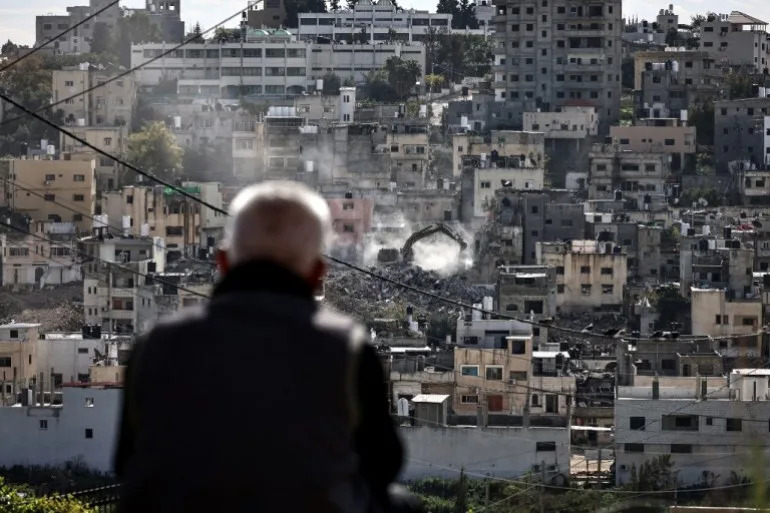
Israeli forces have intensified efforts in the northern West Bank by demolishing numerous buildings that housed Palestinian families, resulting in significant displacement as winter approaches. On Wednesday, military bulldozers leveled residential blocks in the Nur Shams refugee camp, affecting about 100 families. Witnesses reported thick clouds of dust as the demolitions unfolded, with residents observing the destruction from a distance.
One resident, Mutaz Mahr, expressed deep anguish over the loss of his home. “Being torn away from our homes, our neighbourhoods and our memories is deeply painful,” he stated. Mahr, displaced along with approximately 25 relatives, is now sheltering in a 100-square-metre apartment. He reflected on the trauma of displacement, recalling the first time his family faced such an ordeal. “The first time, our grandparents were displaced, and this is the second time,” he lamented as bulldozers advanced.
The Israeli military characterized the demolitions as part of a broader operation targeting Palestinian resistance groups, although this assertion remains unverified. Palestinian residents and human rights organizations have condemned the actions as tantamount to collective punishment and forced displacement under occupation. Nihaya al-Jendi, a member of the Nur Shams popular committee, emphasized the severity of the situation, stating, “Today, more than 1,500 families from the camp are still unable to return. This is a major catastrophe – a real humanitarian disaster for Palestinian refugees – unfolding before the eyes of the world.”
Extent of Destruction and Settlement Expansion
Since the onset of what Israel calls a security operation earlier this year, refugee camps in the northern West Bank, including Tulkarem and Jenin, have faced significant destruction. According to Human Rights Watch, at least 850 homes have been demolished or severely damaged across these camps. The organization’s analysis of satellite imagery suggests that this destruction aims to create “clear buffer” zones, thereby tightening Israeli control over the region.
As homes are demolished, Israel has simultaneously moved forward with plans for illegal settlement expansion. On the same day as the demolitions, Israeli authorities approved the construction of 126 settler housing units in the Sa-Nur outpost. Reports indicate that the High Planning Council, part of Israel’s Civil Administration, approved a detailed plan allowing settlers to return to Sa-Nur, which was evacuated in 2005 as part of a disengagement plan under then Prime Minister Ariel Sharon. This policy was reversed in March 2024 when Israel’s parliament repealed the disengagement law.
International Response and Humanitarian Concerns
The demolitions and settlement approvals coincide with escalating tensions between Israel and the United Nations Relief and Works Agency for Palestine Refugees in the Near East (UNRWA). United Nations Secretary-General Antonio Guterres condemned recent Israeli actions to cut essential services to UNRWA facilities, describing these measures as detrimental to the agency’s operations. UN spokesperson Stephane Dujarric reiterated that UNRWA remains an integral part of the UN system, emphasizing that the agency provides critical education, healthcare, and humanitarian aid to millions of Palestinians across various regions.
UNRWA Commissioner-General Philippe Lazzarini denounced Israel’s actions as part of a systematic campaign to undermine the agency’s work. In 2024, Israeli lawmakers passed legislation prohibiting UNRWA from operating within the country, further complicating the agency’s ability to assist Palestinian refugees. Despite these challenges, UNRWA continues its operations in occupied East Jerusalem, which the UN recognizes as occupied territory, providing vital services to those in need.
As the situation in Gaza continues to deteriorate, observers note that the simultaneous assault on UNRWA and the ongoing demolitions in the West Bank reflect a broader strategy to address the Palestinian refugee question. The humanitarian implications of these actions are profound, raising urgent concerns over the rights and welfare of affected communities.