A team of scientists from NASA has uncovered an extraordinary celestial body, designated as CWISE J1249, which is moving at an unprecedented speed of over 1 million mph across the Milky Way. This discovery, made using the WISE telescope, has sparked significant interest among astronomers due to its unique characteristics and potential implications for our understanding of stellar bodies.
Scientists, led by Martin Kabatnik, have noted that CWISE J1249 possesses an unusually low mass and a metal content that is significantly below that of typical celestial objects. Currently classified as a rogue planet, its origin and trajectory remain uncertain, prompting researchers to investigate further to unravel the mysteries surrounding this cosmic anomaly.
Detection and Characteristics of CWISE J1249
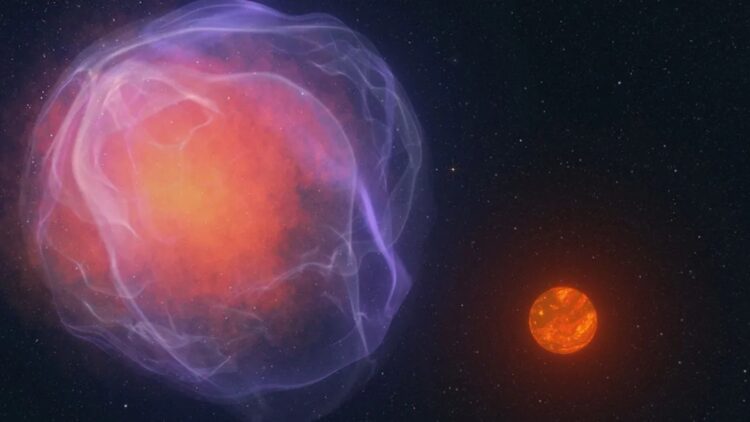
The discovery of CWISE J1249 stemmed from the WISE telescope’s ability to detect infrared light, which allows astronomers to identify and study distant celestial objects. This small red sphere, moving at a remarkable speed, piqued the curiosity of the research team. Initial analyses confirmed its velocity at approximately 1 million mph, but the challenge lay in classifying it accurately.
The findings from the W.M. Keck Observatory revealed that CWISE J1249’s mass was lower than expected, raising questions about its classification as a star or a planet. The low metal content further complicates the identification, making it difficult for researchers to draw conclusive parallels with known stellar bodies.
Theories on Origin and Future Exploration
The striking speed and peculiar physical attributes of CWISE J1249 have led scientists to propose two primary theories regarding its origin. The first theory posits that it could be a remnant of a white dwarf supernova, where a violent explosion may have propelled the object to its current velocity while causing significant material loss.
The second theory suggests that CWISE J1249 may represent a failed star or a rogue celestial body ejected from its original system due to gravitational interactions. Both theories are under consideration, but further investigation is required to substantiate either claim.
As NASA researchers delve into the complexities surrounding CWISE J1249, their immediate challenge is to determine its origin and destination. Currently identified as a rogue planet, this celestial body does not orbit a star, making its trajectory difficult to trace. Researchers emphasize the need to search for elements in situ to locate potential parent sources.
Once the team establishes the origin of CWISE J1249, their focus will shift to identifying similar rogue objects in the cosmos. This groundbreaking discovery not only captivates the scientific community but also has the potential to enhance our understanding of the dynamics of the universe.