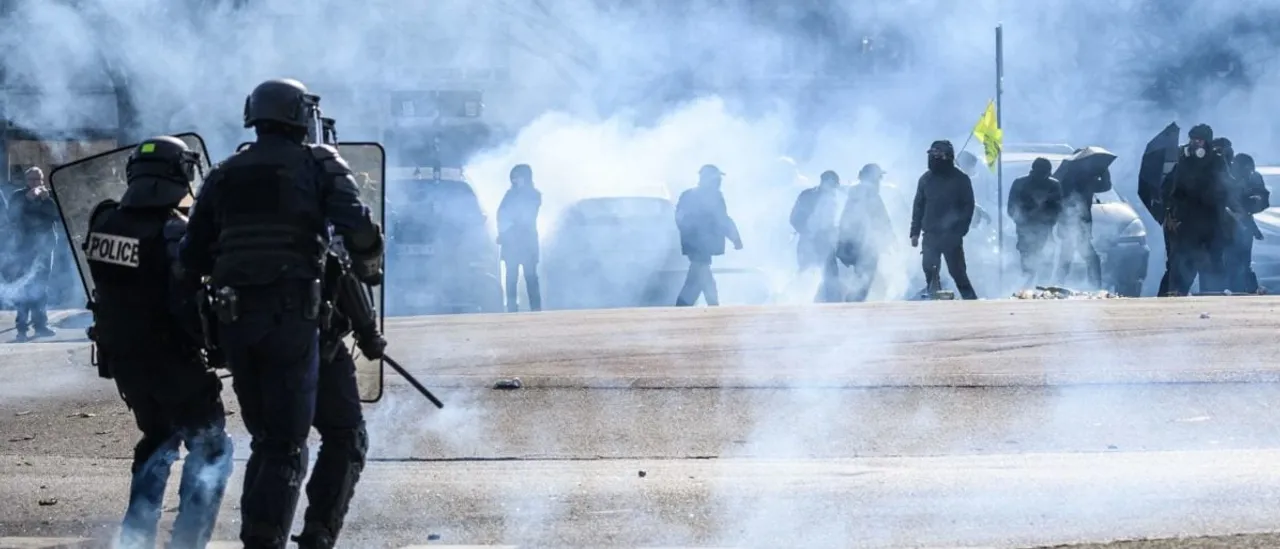
Violence erupted across multiple European cities on New Year’s Eve, resulting in over 420 arrests in Berlin alone, as police faced significant unrest and attacks on emergency services. The Berlin police deployed approximately 3,200 officers for the night’s operations, responding to a staggering 2,340 incidents, according to the State Administration for the Interior and Sport. The fire brigade received around 1,830 emergency calls during the night, reflecting an atmosphere of chaos that permeated celebrations.
In Berlin, authorities expanded “firework-free zones” to mitigate violence, which they credited with helping to prevent injuries and crimes. Despite these precautions, the level of unrest matched that of the previous year, signaling a troubling trend. The police union characterized the incidents as a striking example of a public order breakdown linked to migration, noting that officers were attacked with fireworks and numerous injuries were reported.
Attacks on First Responders and Property Damage
In a detailed statement, the German Police Union condemned the violence, labeling the targeted attacks on emergency personnel as assaults on the state. Union representatives highlighted that the perpetrators “appeared to be predominantly of Arab and Turkish origin.” In some districts, firefighters could only operate under police protection due to the escalating violence.
Police confiscated over 220,000 fireworks ahead of the New Year’s celebrations, including more than 109,000 dangerous Category 4 explosives. Authorities indicated that this preemptive action prevented “hundreds of thousands of dangerous explosions” throughout the night. Nevertheless, the violence’s character persisted, with nearly 400 individuals detained by local law enforcement.
A leaked report from Nius.de indicated that among those arrested in Berlin last year, 264 of the 670 suspects were foreign nationals. This trend of violence and unrest has been echoed in cities across Europe, with authorities expressing concerns over a growing pattern of public disorder linked to migration.
In Belgium, police described New Year’s Eve in Antwerp as “extremely turbulent and dangerous.” Emergency crews faced projectiles such as stones, fireworks, and even a fire extinguisher thrown from rooftops. Approximately 100 arrests were made, predominantly involving individuals under the age of 20. Dutch police reported 250 arrests nationwide, with incidents of Molotov cocktails and paving stones being used against officers in Breda.
Implications and Reactions
The unrest also extended to France, where rioters set fire to 1,173 vehicles, surpassing the previous year’s total of 984. Reports suggest that New Year’s Eve has increasingly become a night marked by attacks from migrant groups using fireworks against both emergency personnel and civilians in major Western cities.
Political figures, including Viktor Orbán’s political director, Balázs Orbán, characterized the events in Berlin as indicative of a broader “migration-based public order breakdown.” He attributed this to years of weak enforcement and mass migration policies, criticizing Brussels for promoting relocation quotas and lenient border controls.
As public safety concerns dominate discussions in European capitals, the events of New Year’s Eve raise critical questions about the effectiveness of existing strategies to ensure order and protect emergency responders in the face of escalating violence linked to demographic changes. The situation continues to evolve, prompting urgent calls for reassessment of policies affecting public safety and community relations across Europe.