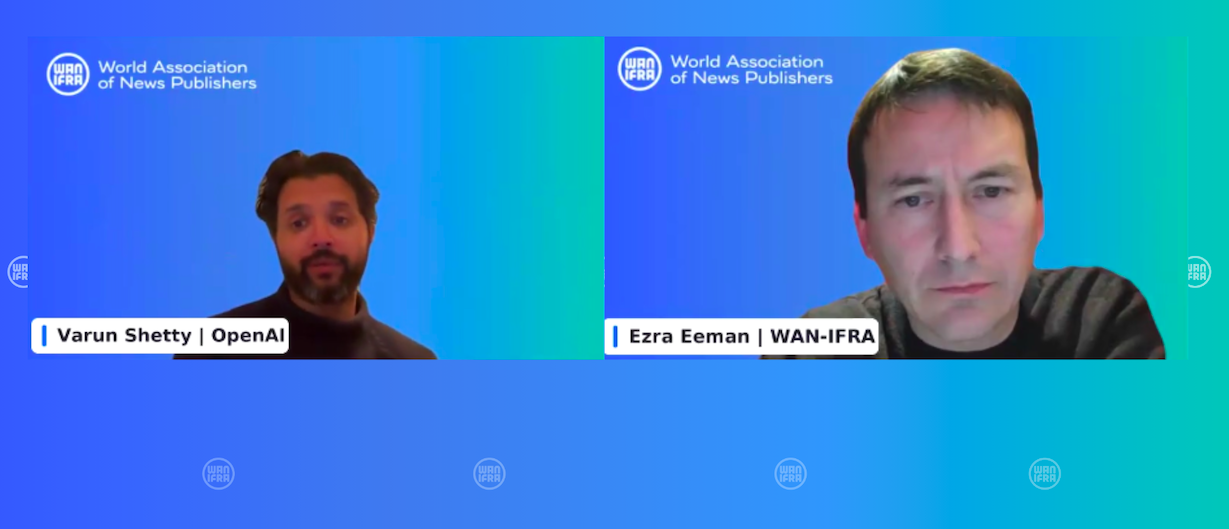
OpenAI has unveiled its ambitious plans for 2026, focusing on transforming its ChatGPT technology from a reactive “answer engine” into a proactive assistant. During a webinar hosted by Ezra Eeman as part of the WAN-IFRA AI in Media Initiative, Varun Shetty, Vice President of Media Partnerships at OpenAI, outlined the company’s priorities, emphasizing enhanced personalisation and proactive user experiences.
Shetty articulated the concept of personalisation, asserting that a human assistant’s true value lies in understanding individual preferences, goals, and habits. “If you had a human assistant, and you could only get information from them by asking them questions, I think you would be unsatisfied with that,” he stated. He highlighted that OpenAI aims to enable ChatGPT to anticipate user needs and present relevant information proactively.
OpenAI’s roadmap includes various innovative features, with the recently launched Pulse serving as a primary example of this proactive approach. Described as a “daily digest,” Pulse searches for information aligned with user interests and delivers it within the ChatGPT interface. While the feature showcases the potential of AI to provide tailored content, Shetty noted that it is currently limited to pro users in the United States due to the high computational costs involved in its operation.
Enhancing Search and Publisher Interaction
Another significant aspect of OpenAI’s 2026 vision is the evolution of ChatGPT Search. Shetty acknowledged that earlier iterations of ChatGPT struggled with real-time information, particularly concerning recent events. OpenAI aims to rectify this through a search experience that utilizes Retrieval-Augmented Generation (RAG) to deliver answers based on reliable sources.
From a publisher’s perspective, Shetty outlined essential requirements, including proper citation, link-out experiences, and a more visually customised search experience. He acknowledged the challenge posed by the format of ChatGPT, which provides answers rather than traditional search results. “The likelihood that they click through is naturally going to be lower than if you just see a link,” he explained, although he remains optimistic about improving click-through rates.
Importantly, Shetty clarified that publishers have control over their content’s visibility within ChatGPT Search. Through adjustments to their robots.txt file, publishers can opt out of being included in search results, ensuring they retain authority over their material. This approach underscores OpenAI’s commitment to creating value for publishers as a means of encouraging their participation.
Exploring Monetisation and Engagement Opportunities
Beyond search and personalisation, Shetty discussed OpenAI’s broader strategy to enhance engagement and monetisation opportunities for publishers. The company is looking to map its offerings to existing publishing economics, focusing on driving traffic, boosting reader engagement, and facilitating conversions. Shetty pointed out that OpenAI’s upcoming commerce product could expand into digital goods, potentially allowing for upselling subscriptions based on user engagement with specific publications.
In terms of monetisation, Shetty outlined a mix of revenue streams, including enterprise products, developer APIs, and consumer subscriptions. He also confirmed the introduction of advertising to OpenAI’s free product and a new subscription tier, ChatGPT Go, launching on January 16, 2024, at a price of $8 per month. This tier will offer expanded features while maintaining a commitment to user privacy, ensuring that advertisements do not influence responses and that user data remains secure.
Shetty’s vision for OpenAI’s role in the media landscape is clear: while the company does not position itself as a media entity, it aims to facilitate access to high-quality journalism and trustworthy information. By providing users with a pathway to credible sources, OpenAI seeks to deepen public understanding of various topics.
The 2026 roadmap reveals OpenAI’s intent to redefine the relationship between technology and information consumption, offering publishers a framework to engage with readers in innovative ways. As the company continues to evolve its AI capabilities, the emphasis on personalisation and proactive assistance could significantly impact how users interact with information and how publishers deliver content in the future.