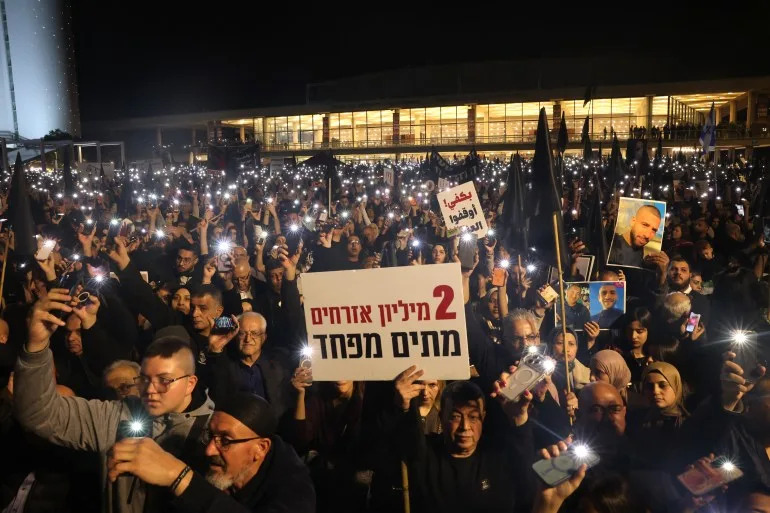
Residents of Palestinian-majority towns in Israel are demanding urgent government action to address rampant organised crime that has infiltrated their communities. In a stark manifestation of their frustration, shopkeeper Ali Zbeedat from Sakhnin recently closed his businesses after receiving a death threat, highlighting the pervasive violence that has plagued his town and others like it. This incident has sparked significant protests, drawing attention to a crisis that many believe is exacerbated by government neglect.
Zbeedat’s decision to shut down his stores came after repeated attacks on his family businesses, including a recent incident where gunmen fired dozens of rounds at one of his shops. The threat he received read, “We know where you go and where you walk. We will kill you if you don’t finish what you’re supposed to.” His plight has resonated widely, igniting protests across Sakhnin and beyond, with tens of thousands of both Palestinian and Jewish Israelis demonstrating in cities like Tel Aviv and Jerusalem.
Aida Touma-Suleiman, a member of the Israeli parliament representing the Hadash-Ta’al faction, emphasized the scale of the violence: “In 2025, 252 Palestinians were murdered in Israel, but that doesn’t tell you everything.” She highlighted the broader implications of crime on daily life, as many residents are forced to allocate a significant portion of their income for protection.
The situation is dire for Palestinian citizens of Israel, who make up around 21 percent of the overall population. Descendants of those who remained during the 1948 Nakba, they often live in isolated towns afflicted by inadequate government support. Observers note a troubling absence of state presence, leading to a Hobbesian environment where crime flourishes unchecked. According to the National Insurance Institute, approximately 38 percent of Palestinian households live below the poverty line, which further compounds their vulnerability.
Unemployment remains a critical issue, worsened by restrictions on access to the occupied West Bank following the escalation of violence in Gaza in 2023. With only 54 percent of Palestinian men and 36 percent of women in Israel holding jobs as of 2024, many are drawn into criminal enterprises as a means of survival.
Touma-Suleiman pointed out that the lack of police presence in Palestinian communities has allowed criminal networks to thrive. She noted that those who once sought better opportunities within Israel often return home with the skills needed to establish these networks. The situation is further complicated by families from the occupied territories who, after the second Intifada in 2005, have relocated to Palestinian areas in Israel and contributed to the rise of organised crime.
On the streets of these towns, gangs resemble hierarchical structures similar to the Italian mafia, operating with a level of impunity that allows them to control essential aspects of local commerce. They engage in activities ranging from drug trafficking to loan sharking, functioning within a financial desert where few have access to legitimate banking services.
Prominent Israeli sociologist Yehouda Shenhav-Shahrabani stated that the perception of danger surrounding these neighborhoods is often misconstrued by outsiders. He argued that the Israeli state’s withdrawal from these areas has allowed violence and criminality to flourish.
Recent protests reflect a growing tide of anger among residents. Demonstrators have taken to the streets carrying banners declaring “Enough violence and murder” and “Arab Lives Matter.” Even Israeli President Isaac Herzog has acknowledged the need for action in light of the escalating violence. Reports indicate that Israeli Prime Minister Benjamin Netanyahu is considering appointing Itamar Ben-Gvir, the controversial Minister of National Security, to lead a task force aimed at addressing the issue.
As the protests continue, the stark contrast between the lives of Palestinian children and their Jewish counterparts becomes increasingly apparent. Hassan Jabareen, the director of the Arab rights organisation Adalah, articulated this disparity, stating, “One will have safety… The other boy will not be able to sleep for the sound of guns.”
The crisis facing Palestinian citizens of Israel is not merely a local issue but a reflection of broader systemic challenges that require urgent attention. As communities rally for change, the call for a more secure and equitable environment grows louder, demanding that the government take decisive action to restore safety and justice.