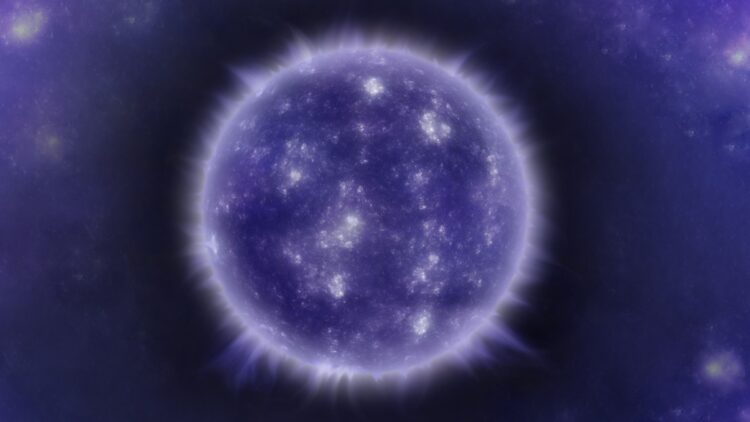
A team of researchers has potentially identified a new class of cosmic objects known as supermassive dark stars using the James Webb Space Telescope (JWST). This discovery could provide insights into longstanding mysteries in physics and cosmology. If confirmed, these findings may reshape our understanding of dark matter and the formation of early supermassive black holes.
Through advanced observations, scientists detected light absorption at a wavelength of 1,640 Angstroms, which is directly linked to dark stars. According to Cosmin Ilie, an astrophysicist at Colgate University, this marks the first time a possible signature of such a star has been found. The detection suggests that these stars contain a core of dark matter particles that interact with one another.
Characteristics of Dark Stars
It’s essential to clarify what dark stars are, as their name may imply a lack of light emission. In reality, these celestial bodies are vast clouds primarily composed of hydrogen and helium. Unlike conventional stars such as our Sun, which derive energy from nuclear fusion, dark stars operate through the self-annihilation of dark matter particles. As Ilie explains, “Supermassive dark stars are extremely bright, gigantic, and fluffy clouds composed mainly of hydrogen and helium, which resist gravitational collapse thanks to the minimal amounts of dark matter that self-annihilate within them.”
The team employing the JWST has identified four of the most distant objects on record in the universe, all aligning with the theoretical characteristics of dark stars. Notably, one of these objects displayed distinctive light absorption at the aforementioned wavelength, indicating its possible identity as a dark star.
Implications of the Discovery
The researchers embarked on this investigation to explore the primitive universe, aiming to uncover unknown celestial bodies. Their observations revealed objects within massive galaxies that appeared to be formed too early for their size, leading to the hypothesis of dark stars. These stars could potentially possess a mass equivalent to 1 million suns and exhibit similarities to galaxies themselves.
Among the four objects analyzed, one appears as a point source of light, while the remaining three show more diffuse characteristics, suggesting they may indeed be dark stars enveloped by nebulas of ionized hydrogen and helium.
This discovery has the potential to answer critical questions regarding the nature of dark matter and its mechanisms. It could also shed light on the formation processes of early supermassive black holes. Although further observations are essential to confirm the identities of these objects, the implications of this research could significantly alter current scientific understanding, as the findings seem poised to challenge established physics.
The research underscores the continuing evolution of our knowledge of the universe, showcasing the depth of discovery made possible through cutting-edge technology like the JWST. As the field of astrophysics progresses, findings such as these remind us of the vast and complex nature of cosmic phenomena yet to be fully understood.