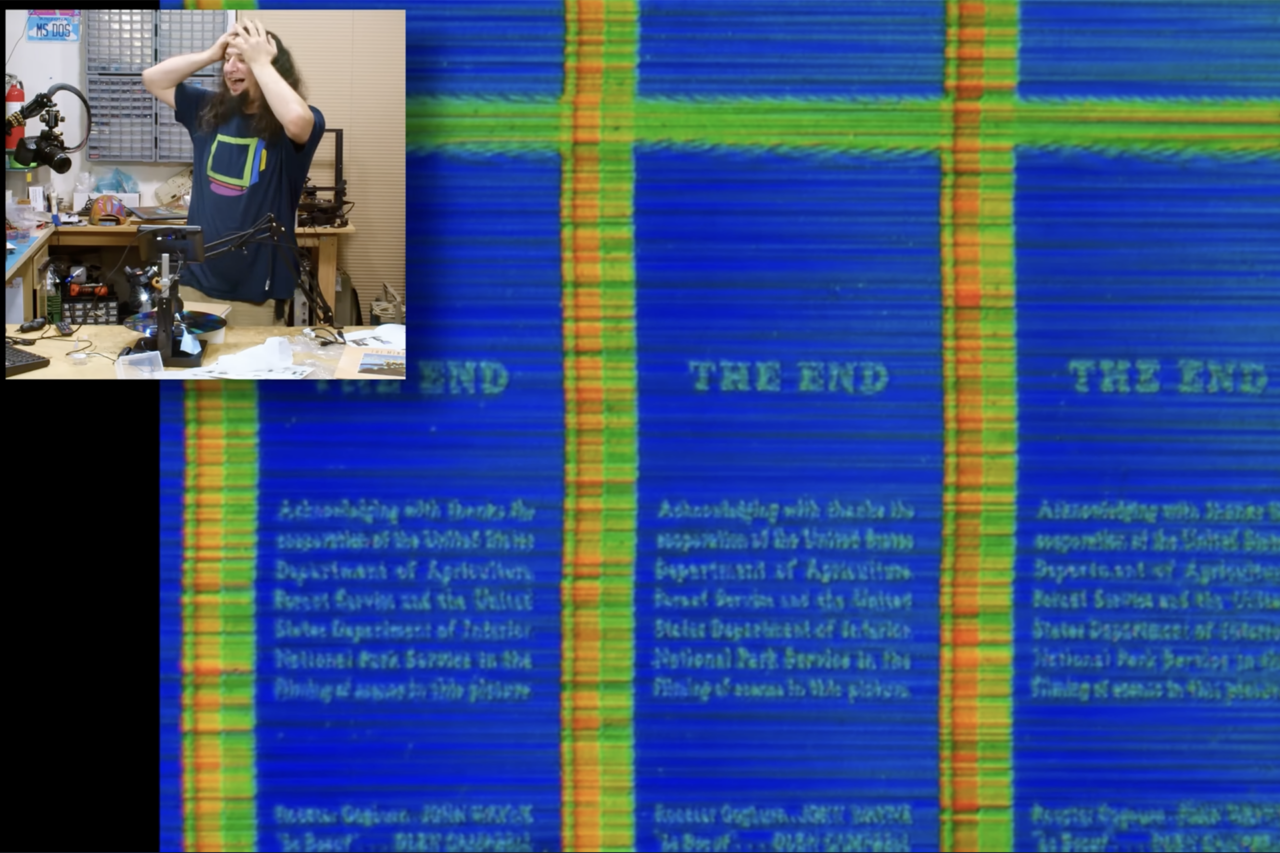
A recent video by YouTuber Shelby Jueden, known as Tech Tangents, has revealed a surprising phenomenon: it is possible to see stored video data on a LaserDisc under a microscope. In his latest review of a microscope, Jueden examined a copy of the film The Mind’s Eye, a computer animation collection. What began as a simple product review turned into a fascinating exploration of how analog video data can be visually represented.
LaserDiscs, while appearing futuristic, are fundamentally an analog format. They store video using two distinct methods: constant angular velocity (CAV) and constant linear velocity (CLV). The choice between these formats significantly impacts the way data is recorded and retrieved. CAV discs spin at a consistent speed, typically at either 1,500 or 1,800 revolutions per minute, allowing for precise frame display. Each revolution contains one complete frame, enabling features like frame-skipping and frame-freezing. In contrast, CLV discs function similarly to compact discs, adjusting their speed to maintain a steady data read rate, ultimately allowing for greater data storage.
During his demonstration, Jueden discovered that each frame on a CAV disc is represented as a series of horizontal scanlines. These scanlines appear in the same location on each track, meaning that when an image is displayed, the video data is organized along the radial axis of the disc. If a vertical scrolling element, such as movie credits, is present during playback, it can be visible on the disc’s surface when viewed through a microscope.
Approximately 18 minutes into the video, as Jueden was about to conclude his segment on The Mind’s Eye, a chat member suggested he attempt to find a visible image on the disc. Initially skeptical, Jueden was surprised to find that the credits from the movie were indeed visible on the LaserDisc surface, correlating precisely with what was being displayed on-screen.
This concept is not limited to LaserDiscs. The capacitance electronic disc (CED), an analog video format developed by RCA, also exhibits similar properties. Jueden’s findings highlight a unique interplay between analog technology and modern digital data storage methods. In an era dominated by digital streaming and storage solutions, witnessing a physical representation of video data feels like a nostalgic journey back to the roots of visual media.
The significance of this discovery lies in its implications for understanding how data is stored and represented. While current technologies rely heavily on binary code, the basic principles of data storage remain the same. The ability to view actual images on a disc serves as a reminder of the evolution of video technology and the foundational concepts that underpin both analog and digital formats.
Jueden’s exploration not only engages viewers with a sense of wonder about the past but also offers an avenue for deeper discussion regarding the future of data storage and retrieval methods. As technology continues to advance, the fascination with these earlier formats, such as LaserDiscs and CEDs, remains relevant, providing insights into the ongoing evolution of media consumption.