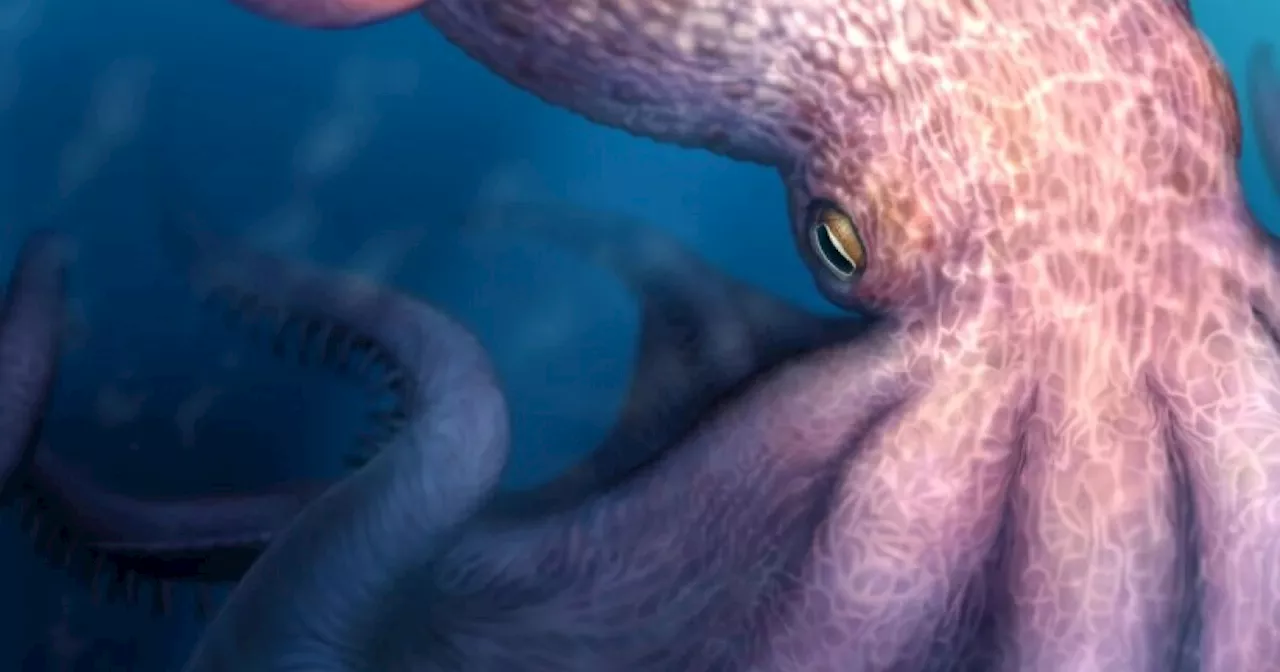
Giant 60-Foot Octopus Fossils Unearthed in Japan Reveal Ancient Sea Giant
Researchers have uncovered fossilized jaws of a massive octopus measuring up to 60 feet long, rivaling giant apex predators of the Late Cretaceous oceans in what is being called a groundbreaking discovery. These fossils were found embedded inside ancient seabed rocks in northern Japan and provide unprecedented insight into a creature that lived over 100 million years ago.
The international research team, led by paleontologists Takao Iba from Hokkaido University and Klaus Mutterlose from Ruhr University Bochum in Germany, utilized an innovative digital fossil-mining technique powered by AI to slice open concretions — hard rocks where soft-bodied animals like octopuses rarely preserve. This method revealed the elusive fossils of octopus jaws, which are composed of hard tissue capable of fossilization.
Unprecedented Size Suggests Cretaceous Seas Teemed with Monster Predators
Octopus jaws usually fossilize poorly, leaving gaps in our understanding of their evolution and ecology. But the jaws recovered in Japan were the largest ever found, with size estimates indicating the octopuses stretched well beyond today’s largest species, such as the giant Pacific octopus known for arm spans up to 16 feet. These ancient octopuses could have been up to four times that size, making them dominant hunters in their marine world.
Mutterlose explained the physical evidence from the jaws, showing numerous chips and scratches likely caused by crushing hard-shelled prey like shrimp, lobsters, bivalves, and nautilus-like animals. “These weren’t passive creatures—they were active carnivores with powerful arms tearing apart their meals,” he said.
Clues to Octopus Intelligence and Hunting Behavior in Ancient Oceans
The fossils suggest striking anatomical features, including more wear observed on the right side of the jaws, implying these octopuses might have favored one side like modern cephalopods. This lateralized feeding behavior hints that complex brain development and advanced intelligence—hallmarks of modern octopuses—may have been evolving 100 million years ago.
“Our results suggest that some of those remarkable traits may already have been emerging in early octopuses during the Cretaceous,” said lead researcher Iba.
Their discovery paints a vivid picture of the Late Cretaceous seas, which hosted a diverse array of gigantic predators like mosasaurs and early ancestors of today’s cephalopods. This ecosystem was a fierce battleground teeming with hungry marine giants competing for survival.
Why This Discovery Matters to Science and History
Finding fossilized remains of a soft-bodied creature like an octopus is extraordinarily rare. It provides scientists with direct evidence that deepens our understanding of evolutionary biology, predator-prey relationships, and brain development millions of years before modern octopuses roamed the oceans.
“Just a few key fossil specimens like this can illuminate entire chapters about the evolution of marine life,” Mutterlose said. “We’re only beginning to understand how exceptional these ancient creatures were.”
The Future of Fossil Research: AI and Digital Reconstruction
The team’s use of AI-assisted 3D modeling to digitally reconstruct fossils from rock slices represents a cutting-edge advance in paleontology, promising to unlock many more secrets currently hidden in hard-to-examine mineral formations worldwide.
As technology improves and more sites are explored, expect deeper revelations on ancient marine ecosystems and the creatures that dominated Earth’s oceans 100 million years ago.
This exciting discovery not only uncovers a forgotten giant but also challenges long-held assumptions about the evolutionary roots of octopus intelligence and versatility—traits still astonishing marine biologists today.